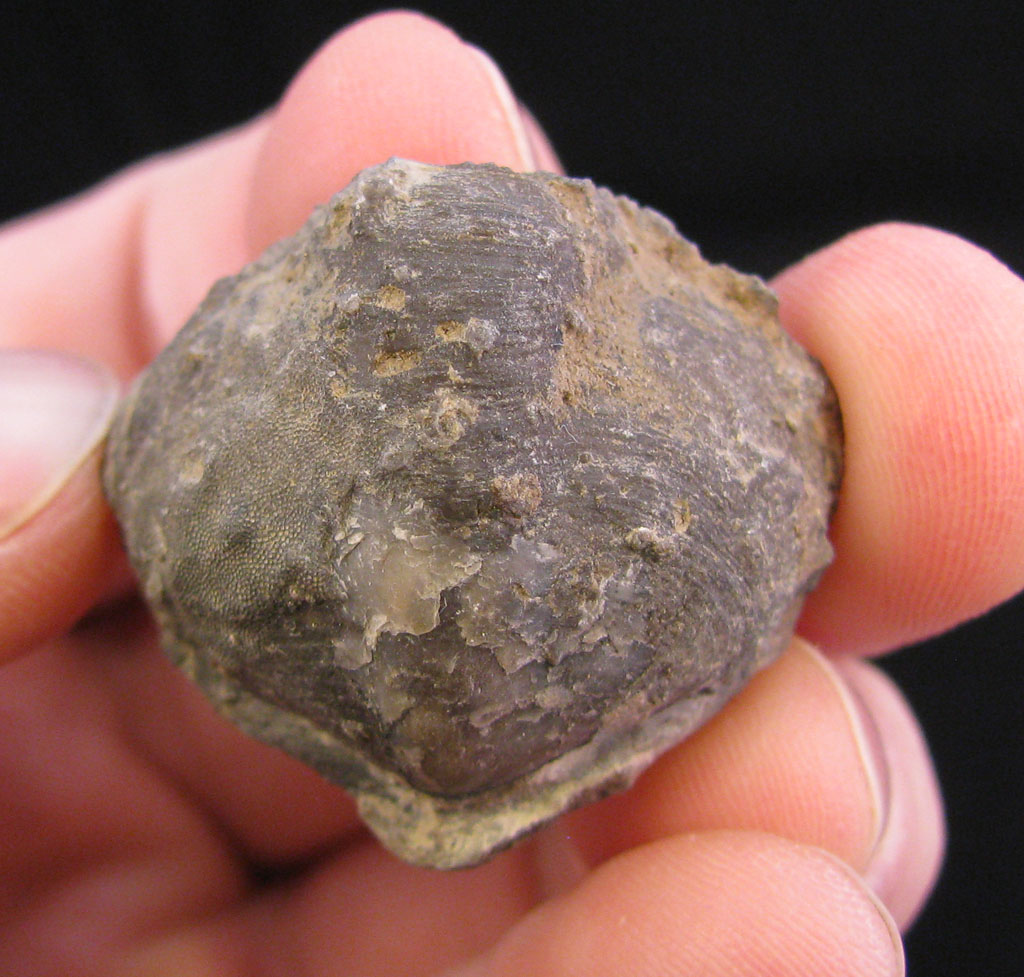
Subtransnema sp. brachiopods remind me of Protodouvillina sp. brachiopods. They both look similar in shape and have thin radial lines on the surface of the pedicle valve. The specimen below is from the Hallert member of the Ahbach Formation (Devonian, Givetian stage) near Blankenheim, Germany.
Pedicle valve
Anterior
Brachial valve
Posterior
Profile
For comparison purposes I've blogged about Douvillina interstrialis from Poland, Douvillina arcuata from Iowa and Protodouvillina inaequistriata from New York and Ontario.
Thanks go out to Nils for sending me this specimen.
Monday, March 10, 2014
Saturday, March 8, 2014
Leptaena sp. brachiopod from Germany
Leptaena is a genus of Brachiopod that existed from the Ordovician up into the Carboniferous and it's look didn't change much in all that time. It's no surprise to find this hardy species in lower Devonian (Eifelian stage) rocks from Germany.
Specimen #1
Pedicle valve
Anterior
Brachial valve
Posterior
Left profile
Right profile
Specimen #2
Pedicle valve
Anterior
Right profile
Left profile
These specimens compare well with those I've blogged about before from the Lower Devonian of Oklahoma, Ordovician of Russia, Lower to middle Devonian of Poland and Silurian of New York.
Both of the above specimens come from the Junkerberg Formation (Devonian, Eifelian stage) near Gerolstein, Germany. Thanks to Nils for the fossils.
Thursday, March 6, 2014
Athyris tumida brachiopod from Sötenich, Germany
Another new Athyris species that I received in my exchange with Nils is this Athyris tumida from the Rodert member of the Cürten Formation (Devonian, Givetian stage) near Sötenich, Germany. This is a more robust species that A. amanshauseri or A. spiriferoides with the shell being nearly as tall as it is wide.
Pedicle valve
Anterior
Brachial valve
Posterior
Profile
Thank you Nils for this fossil.
Pedicle valve
Anterior
Brachial valve
Posterior
Profile
Thank you Nils for this fossil.
Tuesday, March 4, 2014
Athyris amanshauseri brachiopod from Sötenich, Germany
I recently completed a trade with a new friend in Germany. He sent me a number of fossils from the Devonian rocks of Germany in exchange for some of my fossils from New York and Ontario. I was quite excited when I saw the specimens below were Athyris as it gives me another species to compare to A. spiriferoides from New York, A vittata from Michigan.
This is Athyris amanshauseri (Spriesterbach 1935) and it comes from the Rodert member of the Cürten Formation (Devonian, Givetian stage) near Sötenich, Germany. My first impressions are that is has a similar width to A. spiriferoides but the growth lines on the shell are more pronounced and even overlapping like scale mail armor. You can see this effect best in the picture of the pedicle valve below. A. spiriferoides has a similar growth pattern in it's shell however it is most often see near the edges of the shell rather than towards the middle as in these specimens.
Brachial valve
Anterior
Pedicle valve
Posterior
Profile
This second specimen of A. amanshauseri has a bit of Fenestella like bryozoan that was fossilized along with the shell.
Brachial valve
Anterior
Pedicle valve
Posterior
Profile
Thanks to Nils for these fossils.
Sunday, March 2, 2014
Mold of a large Bryozoan from the Mahantango Formation
This piece is a mystery to me as well as an uncommon fossil from the Mahantango Formation. It's a mold of a large, rambling Bryozoan colony. There is little detail preserved of the exterior save for the internal zooid molds. I have not been able to determine if there are any monticules present which could help with the ID.
I'm thinking this is some sort of Fistulioporid species of Bryozoan but I can't find anything in the literature that would give more of a clue to narrow down the species.
The above specimen was found near Seven Stars, PA in the Mahantango formation, Upper Shale member (Devonian, Givetian stage)
I'm thinking this is some sort of Fistulioporid species of Bryozoan but I can't find anything in the literature that would give more of a clue to narrow down the species.
The above specimen was found near Seven Stars, PA in the Mahantango formation, Upper Shale member (Devonian, Givetian stage)
Subscribe to:
Posts (Atom)