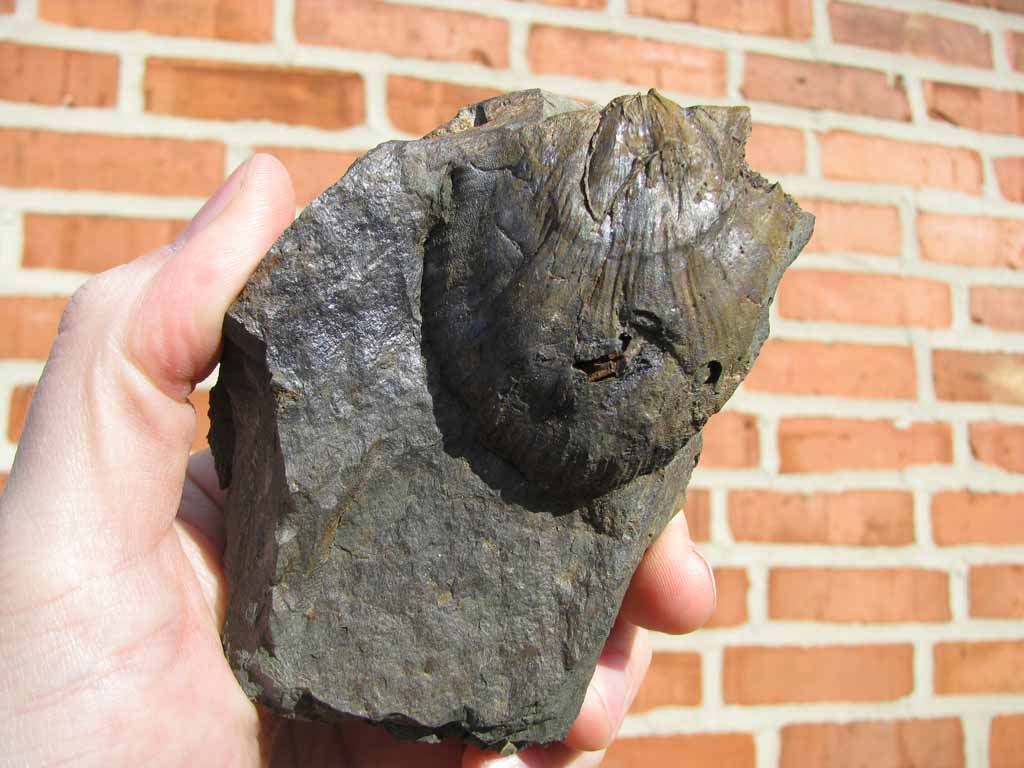
On my trips up to Canada I make a point to get up to the Brechin area and visit the Ordovician aged rock quarries. On one such trip I found the piece below which is rife with a Monoplacophoran called Archinacella patelliformis. Monoplacophorans (latin for "bearing one plate") are gastropod like mollusks which have a cap shaped shell rather than a spiral shape. They are considered very primitive and there is thought that they are representative of the original ancestor of all mollusks.
Upon a wide view one doesn't see too much but the eye is drawn to the light colored oval resting on the darker colored fossil (possibly a bit of Trilobite skeleton).
A closer view reveals that the oval is actually a shell with growth rings.
Here is another view with the light angled so you can see the shell details a bit better.
As I looked over the rock some more I found several more specimens of this unusual fossil. I think I found seven examples of varying sizes on this same piece of rock.
Here is another specimen that I found on a different trip. It's from a different layer as you can see from the way the limestone has weathered. Again you don't really notice it unless your looking for something that doesn't fit. I picked up this piece intitially because of the Sowerbyella brachial valve and the partial Flexicalymene cephalon.
Upon closer inspection I saw the cap like shell of a Monoplacophoran.
An even closer view. Note that the very top of the shell is nearly flat.
The specimens above were found in the Verulam formation which is middle Ordovician in age (Katian stage, equivalent to the lower Caradocian stage in Europe and the Mohawkian stage in the US). I based my ID of the fossils on the book "South-Central Ontario Fossils, A Guide to the Ancient Marine Life of the Region" by William A. Hessin, 2009. Thanks to my friends Kevin and Joe for taking me to these quarries in the first place.
Sunday, January 8, 2012
Friday, January 6, 2012
Pleurocystites squamosus from the Verulam fm.
Pleurocystites is a somewhat common cystoid found in the middle to upper Ordovician. I've managed to find one in the Verulam formation of southern Ontario. The specimen displayed below is a Pleurocystites squamosus and was cleaned off by my friend Kevin. It is associated with a Rafinesquina alternata (white shell), a couple of what I think are Plaesiomys brachiopods along with other brachiopod and bryozoan debris.
A closer view of the calyx. You can see just the stumps of the two arms that once sprouted from the top of the calyx. Unfortunately they must have weathered away or were on another piece of rock that this one broke off of.
One of the interesting features are the "vent" like openings, called dichopores, that are found in three places around the body. This is a closer view of one. Based on what information I have been able to find so far, dichopores were respiratory structures.
The specimen above was found in the Verulam formation which is upper Ordovician in age (Katian stage, equivalent to the lower Caradocian stage in Europe and the Mohawkian stage in the US). Thanks to my friend Kevin for the field ID and for cleaning the fossil off in his prep lab.
A closer view of the calyx. You can see just the stumps of the two arms that once sprouted from the top of the calyx. Unfortunately they must have weathered away or were on another piece of rock that this one broke off of.
One of the interesting features are the "vent" like openings, called dichopores, that are found in three places around the body. This is a closer view of one. Based on what information I have been able to find so far, dichopores were respiratory structures.
The specimen above was found in the Verulam formation which is upper Ordovician in age (Katian stage, equivalent to the lower Caradocian stage in Europe and the Mohawkian stage in the US). Thanks to my friend Kevin for the field ID and for cleaning the fossil off in his prep lab.
Wednesday, January 4, 2012
Verulam formation overview
I'm going to have a series of posts coming up that deal with fossils that I've found in the Verulam formation on southern Ontario, Canada. I've trekked up to quarries in the Brechin area a few times in the last couple of years and have only recently sat down to photograph and write about the fossils that I've brought back. My friends Joe and Kevin were the first to introduce me to this formation and the treasures it holds two years ago.
To get started, here is a picture of one of the quarries. All the rocks you see are part of the Veurlam formation
Here is another view from inside the quarry looking back towards where the first picture was taken. The layers of rock are nearly horizontal in their position as there have not been any mountain building orogonies in this part of the North American continent in millions of years.
Collecting is simple enough since most of the quarry is well weathered. The quarry is active and the best stuff is often found in the recently dislodged rock after a blast but there is enough other material around from earlier operations that it is not difficult to locate a nice specimen or two. Like any fossil locality much of what you find are common fossils but there are quite a few different species found here and the more uncommon and rare species seem to be easier to find.
The Verulam formation is upper Ordovician in age (about 450 mya) and is placed within the Katian stage based on the International Commission on Stratigraphy's time scale (Click Here for the chart). To place it within the stratigraphic positions more commonly used in North America, it is equivalent to the Mohawkian stage. In the UK it is equivalent to the lower Caradocian stage that is more commonly used there. As such, the fossils found here are similar to those found in the Ohio/Indiana/Kentucky/Tennessee region of the US but are slightly older since the Cincinnatian stage (local term for the Hirnantian and part of the Katian stages of the upper Ordovician) are 449-440 mya. The Verulam formation is bounded by the Bobcaygeon formation below and the Coburg formation above.
For the next month or so, all the fossils that I will be writing about will be from the Verulam formation. I hope you enjoy reading about them and seeing my pictures as much as I have had finding and researching them.
To get started, here is a picture of one of the quarries. All the rocks you see are part of the Veurlam formation
Here is another view from inside the quarry looking back towards where the first picture was taken. The layers of rock are nearly horizontal in their position as there have not been any mountain building orogonies in this part of the North American continent in millions of years.
Collecting is simple enough since most of the quarry is well weathered. The quarry is active and the best stuff is often found in the recently dislodged rock after a blast but there is enough other material around from earlier operations that it is not difficult to locate a nice specimen or two. Like any fossil locality much of what you find are common fossils but there are quite a few different species found here and the more uncommon and rare species seem to be easier to find.
The Verulam formation is upper Ordovician in age (about 450 mya) and is placed within the Katian stage based on the International Commission on Stratigraphy's time scale (Click Here for the chart). To place it within the stratigraphic positions more commonly used in North America, it is equivalent to the Mohawkian stage. In the UK it is equivalent to the lower Caradocian stage that is more commonly used there. As such, the fossils found here are similar to those found in the Ohio/Indiana/Kentucky/Tennessee region of the US but are slightly older since the Cincinnatian stage (local term for the Hirnantian and part of the Katian stages of the upper Ordovician) are 449-440 mya. The Verulam formation is bounded by the Bobcaygeon formation below and the Coburg formation above.
For the next month or so, all the fossils that I will be writing about will be from the Verulam formation. I hope you enjoy reading about them and seeing my pictures as much as I have had finding and researching them.
Monday, January 2, 2012
Megastrophia (?) internal cast from the Mahantango fm.
This is the last of my posts regarding the fossils I found in the quarry at Roseburg, Pennsylvania. It's a large internal mold of the pedicle valve from what I believe is a Megastrophia. I base this ID on the sheer size of the fossil as there are not many other genera that attained the size that Megastrophia did.
A closer view of the fossil. You can see the beak like area where the muscles for the pedicle were attached. The pedicle muscles were what the brachiopod used to anchor itself to the sea floor
The muscle scars are well detailed and you can see what looks like a worm tube or bryozoan that grew on the interior surface of the shell as it laid on the sea floor. This implies that the shell was exposed on the surface of the sea bed before being completely buried. You can also see small stipples or pits all over the fossil. Presumably these were attachment points for other muscles in the shell.
I've written about Megastrophia before that I found in the Silica Shale near Sylvania, OH. The specimen in this post came from the Mahantango formation which is from the middle Devonian (Givetian stage).
A closer view of the fossil. You can see the beak like area where the muscles for the pedicle were attached. The pedicle muscles were what the brachiopod used to anchor itself to the sea floor
The muscle scars are well detailed and you can see what looks like a worm tube or bryozoan that grew on the interior surface of the shell as it laid on the sea floor. This implies that the shell was exposed on the surface of the sea bed before being completely buried. You can also see small stipples or pits all over the fossil. Presumably these were attachment points for other muscles in the shell.
I've written about Megastrophia before that I found in the Silica Shale near Sylvania, OH. The specimen in this post came from the Mahantango formation which is from the middle Devonian (Givetian stage).
Sunday, January 1, 2012
Fenestellid bryozoan from the Mahantango
Among the fossil hash layers resent at the quarry in Roseburg was this suprisingly large example of a Fenestellid bryozoan. I last showed you some interesting Fenestellid bryozoan pieces about a year and a half ago in this post, but the specimen below is a new high point for me.
The specimen covers the face of the matrix to a width of about three inches and a height of one inch. It is preserved as a negative mold of the original calcareous skeleton.
The individual zooecia are very small but preserved well enough that I can see the growth pattern of the colony. Each of the little round dots that you see are the negative spaces between the skeleton. The zooecia are even smaller and can only be viewed with a strong magnifier.
Another of the fascinating aspects to this fossil is seen when viewed from the bottom as though you had laid the specimen flat on a table. If you look closely you can see where other sections of the Fenestellid are lain down parallel to each other. This implies a 3-D structure of some sort when the colony was alive.
I imagine the colony originally looked something like an open book with pages that stuck up and fanned out once the spine was laid flat. Of course it could just be multiple flat colonies that were stacked on top of each other during a storm event. It's too bad I could not find more pieces to the puzzle so that I could see if they interconnected.
The specimen covers the face of the matrix to a width of about three inches and a height of one inch. It is preserved as a negative mold of the original calcareous skeleton.
The individual zooecia are very small but preserved well enough that I can see the growth pattern of the colony. Each of the little round dots that you see are the negative spaces between the skeleton. The zooecia are even smaller and can only be viewed with a strong magnifier.
Another of the fascinating aspects to this fossil is seen when viewed from the bottom as though you had laid the specimen flat on a table. If you look closely you can see where other sections of the Fenestellid are lain down parallel to each other. This implies a 3-D structure of some sort when the colony was alive.
I imagine the colony originally looked something like an open book with pages that stuck up and fanned out once the spine was laid flat. Of course it could just be multiple flat colonies that were stacked on top of each other during a storm event. It's too bad I could not find more pieces to the puzzle so that I could see if they interconnected.
Subscribe to:
Posts (Atom)