Sunday, October 9, 2011

More Rudists from France

Here are a few more Rudists from France. This is a Radiolites trigeri from the Cretaceous (Turonien) near Charente, France.You can see the thick exterior walls surrounding the hollow area where the body would have been. Now it's full of Calcite crystals.


A side view showing the full length and depth of the specimen. This fossil represents the base and a portion of the full shell but is not complete top to bottom.


A close up of the Calcite crystals within the body chamber.

This is a portion of a rudist called Hippurites. It's a much smaller fossil than the above specimen and I'm not sure if it is a cast of the body chamber or a portion of the external shell.


Thanks to Gery for sending me these fossils.

Friday, October 7, 2011

Laperousia crateriformis

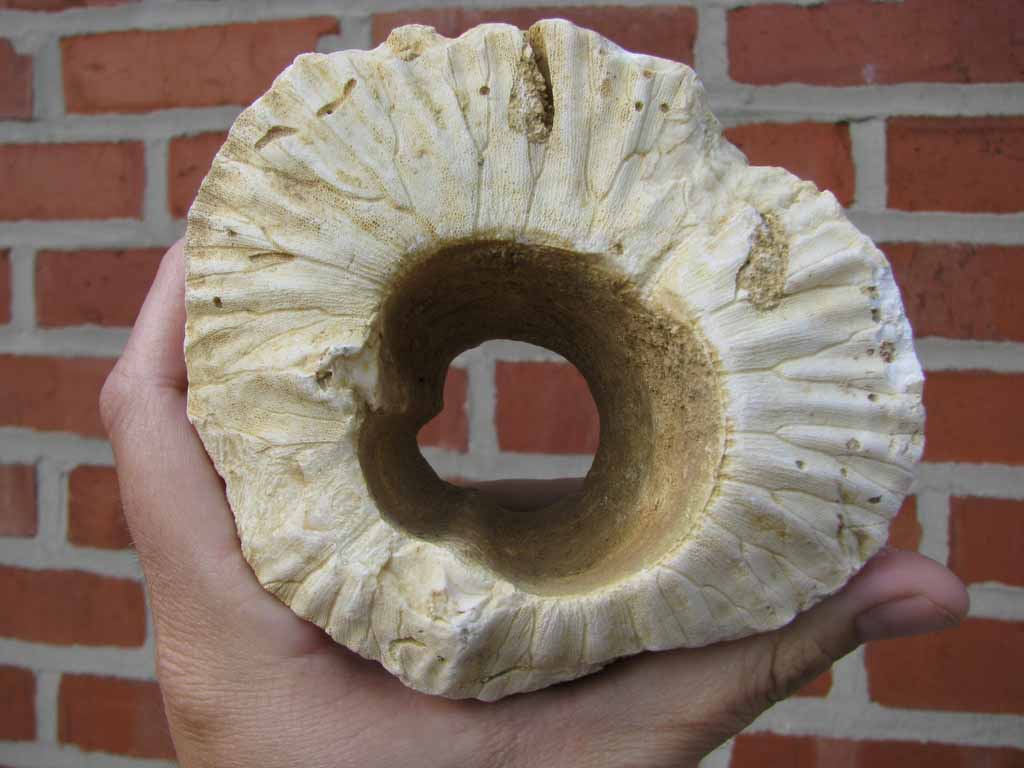
Rudists are a class of Pelcypods that have one valve that is much larger than the other. They are best known for being reef builders during the Cretaceous. Below is a specimen of Laperousia crateriformis from the Cretaceous (Cenomarian) near Magnac, France. It is just one of the valves from the animal.

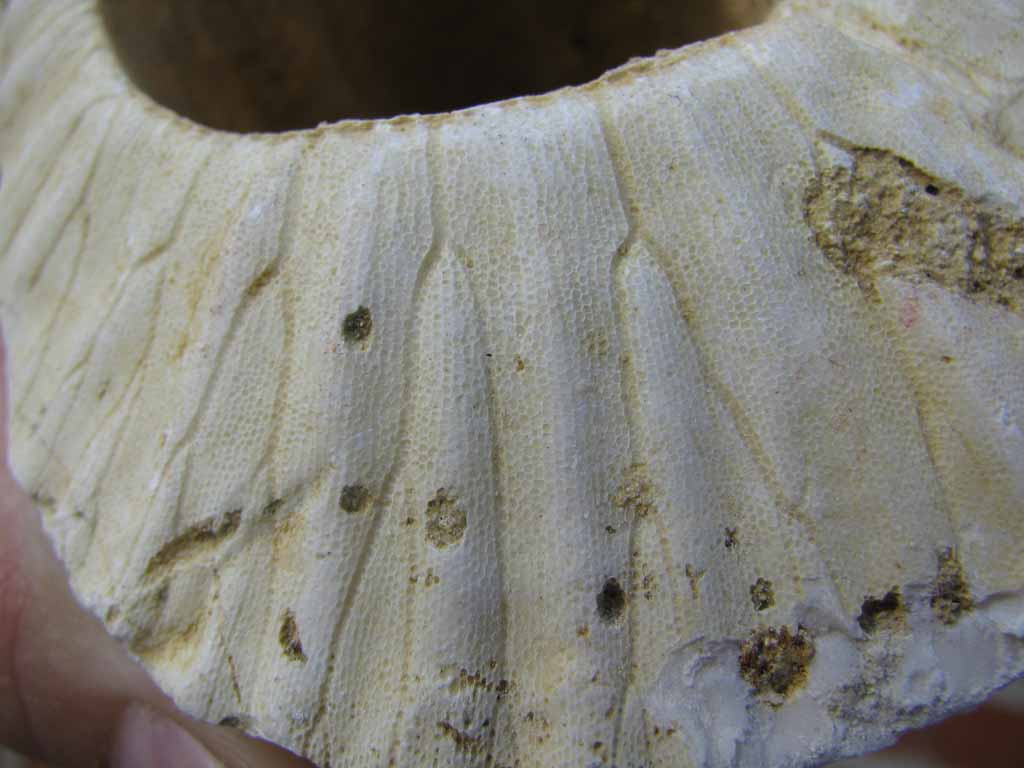
In the top view you can see "veins" and patterning along the edges where the other valve (which would have been flat or slightly domed) would have rested.


This is a view into the body chamber where the animal lived.

Side view showing layered growth.

Bottom view of the specimen. This was not the very base but just a small portion of a much larger structure.

Wednesday, October 5, 2011

Favosites turbinatus from the Jeffersonville limestone

While visiting my friend Mike in Louisville he took me over to a site that has an exposure of the Jeffersonville limestone. The exposure is right about at the Coral Bed level so you can find a large variety of coral species preserved with "Beekite" quartz.

One of the specimens I found was this Favosites turbinatus that was hidden in amongst some old brush and weeds. The classic shape of a rounded base that curved off to one side and the mounded top gave it away. These first four views are of the specimen from all sides.


This is a view of the bottom.

The small hole gives a window into the interior structure which shows the hexagonal shapes of the individual corallites and shows them radiating out along with the rest of the structure. Note the round "Beekite" that covers the exterior of the base.

This is a view of the very top of the specimen where the mound would have been exposed to the open water. You can again see the radial nature of the growth.

This is a side view of the upper portion of the specimen that shows off the honeycomb like structure that is so typical of Favosites species.

A final look at the "Beekite" replaced base where it meets the honeycomb like corallites.


Here is another specimen that is a little smaller than the previous one. It's not as completely preserved but the overall structure and shape is well represented.


The sides of the base are preserved very well on this specimen and you can see how the individual corallites lined up along side each other pointing inwards and upwards.


I've also blogged about these same corals (and formation) in this post and again about a specimen I found in Arkona in this post.

Monday, October 3, 2011

Halysites from the Louisville Limestone

I've discussed the Halysites coral from the Lousiville limestone before in this post. Since then I've had the opportunity to collect some for myself.

These next two pictures show you a piece of limestone with the coral still preserved within. The straight parallel lines, representing a lateral section through the coral, heralding the presence of Halysites within.

Viewed end on you can see cross sections through the corallites.

It's very easy to find specimens that are replaced with "beekite" quartz and have weathered free of the limestone.


This is a view of the bottom of the above pictures piece. You can see some areas that a smooth and others that are open to the corallite. I believe the smooth areas are the base of the corallites where they contacted the mud surface. Not all of the bases are at the same level with each other This could be becasue the muddy bottom surface raised as the coral grew and budded out so that younger corallites would have set their "roots" in the sediment at the level it was when they started to grow.

This piece shows that the colonies could grow fairly tall.

One more small piece.


Thanks to Mike and Kenny for showing the spot to find these fossils!

Saturday, October 1, 2011

Heliolites from the Louisville Limestone

Among the most common corals in the Silurian aged (Homerian to Gorstian) Louisville limestone is Heliolites. It forms wide, flat and rounded colonies but generally do not form mounds.

This is a prototypical colony which has fairly good detail preserved. It could be the species Heliolites romingeri but a thin section and clue study of the minute structures within the individual corallites would be required to confirm.


Note the underside of the colony which forms a kind of shelf with a variable width, "wrinkled" surface. This possibly indicates that it was on the bottom of the sea floor settled in the mud rather than raised above it.


Here you can see a cross section through the coral. Note the many tiny columns, each of which represented a single coral polyp.


This is a second specimen which is not as well preserved but still shows some of the same features.


Thanks to Mike and Kenny for the ID help!