Showing posts with label Trace fossil. Show all posts

Tuesday, April 14, 2020

Fossilized burrow traces from the Moscow formation


I don't usually collect random fossil traces when in the field, but I felt these two examples would be worth saving. I'm not sure what the official genus and species name is for them but they are nice examples of small worms (maybe trilobites or another arthropod?) burrowing through the Windom shale when it was still mud.

Specimen #1


Specimen #2 has some pyrite preservation.

These specimens were found at a borrow pit on Deep Springs Road in Madison County, NY which exposes the Windom shale member of the Moscow formation (middle Devonian in age, Givetian stage.)

Monday, March 9, 2015

Clionolithes sp. borings (?) in M. arkonensis shells from Arkona

A trip to Arkona last fall yielded a fine specimen of Mucrospirifer arkonensis that is perhaps the most complete specimen I've found to date. I found it while attempting to traverse the always slippery Arkona formation (Devonian, Givetian stage) and noticed it sticking out of the hillside. It also shows signs of another kind of trace fossil that I've not seen before. Here is the shell fossil showing that it is about 90% complete missing only the very tips of the wings that project along the hinge line. But notice also the little pepper like flecks that are scattered across the surface.
A closer view of those flecks show that they are, in fact, trace fossils from some kind of burrowing organism. Interestingly, they appear to be concentrated in the brachial valve and seemingly spread from the hinge line towards other parts of the shell.
A closer view

In doing a little research they look similar to borings that a sponge would make and there is a known genus,  Clionolithes, that has been erected to account for these. Most of what I can find on Clionolithes is based on fossils from the upper Devonian and speaks of radiating or branching features. The specimen I have does not appear to show clear lines that radiate from a central point but they do show some evidence of branching occasionally. As I study them they almost appear like stitches in cloth whereby the burrow seems to rise and fall through the shell. Perhaps these are actually worm borings rather than sponge but I can't find any good info to indicate other wise.


I found a second specimen on that same trip that shows similar markings along with some Aulopora elleri on the surface.


Hopefully I will find more specimens with this feature on them during future trips to Arkona. I'd like to see if they are isolated to M. arkonensis or if they also appear on other species.

The only other evidence of boring sponges that I personally have found are of Cliona cretacica on oyster shells from the Cretaceous sediments of Delaware and New Jersey.

Wednesday, January 14, 2015

Possible coprolites from the Utica Shale

I found two interesting fossils in the Utica shale (Ordovician, Darriwillian stage) while looking for Trilobites this past fall. Both appear to be crushed and disarticulated remains of Triarthrus eatoni Trilobites. The difference between these specimens and others that are disarticulated is that these show no hint of organization and are broken into shapes not normally seen in molts. There are also small brachiopods scattered among the remains. I'm thinking these are corprolites from a large cephalopod or other predator who ate Triarthrus eatoni. The Brachiopods could be present because they colonized the coprolite as a hard substrate in an otherwise muddy sea floor.

Specimen #1


Specimen #2


Friday, January 2, 2015

Trace fossils from near Avoca NY

Among the rocks in the large road cut north of Avoca, NY on I-390 (that I blogged about a couple of days ago) were these trace fossils. The rocks are of Upper Devonian age (Fransian stage) from the Gardeau formation of the West Falls Group. At that time the shore line was just east of Avoca and the paleoenvironment was a near shore shelf that was very close to stream and river deltas. These trace fossils probably represent worms burrowing through the substrate in search of food particles.

This one appears to be the top of a vertical burrow where the worm living inside would extend itself out and sweep the nearby sediment for food. The pinwheel like pattern could be an example of the creature systematically covering all the area around the burrow.


These traces are of horizontal burrows, possibly in a very shallow, tidal environment.


Saturday, October 4, 2014

Fossil starfish and their traces

I'm showing off some starfish today starting with these Asteriacites lumbricalis from the Raethian stage of the Triassic that were found near Dijon, France. They are classified as trace fossils since they are the resting traces of starfish that later moved on. From what I can find, the theory is that the starfish burrowed into softer sediment to protect themselves when stranded during low tides. The burrows were filled in with sand once the tide came back in and the occupants crawled back into the sea. They are found from the Ordovician onwards to today.


This blog touches on these fossils briefly and has a modern example as well (scroll down about 1/2 way).
There is a brief article on Wikipedia about Asteriacites with some other pictured examples.

I have some other examples that I wrote about previously Here.

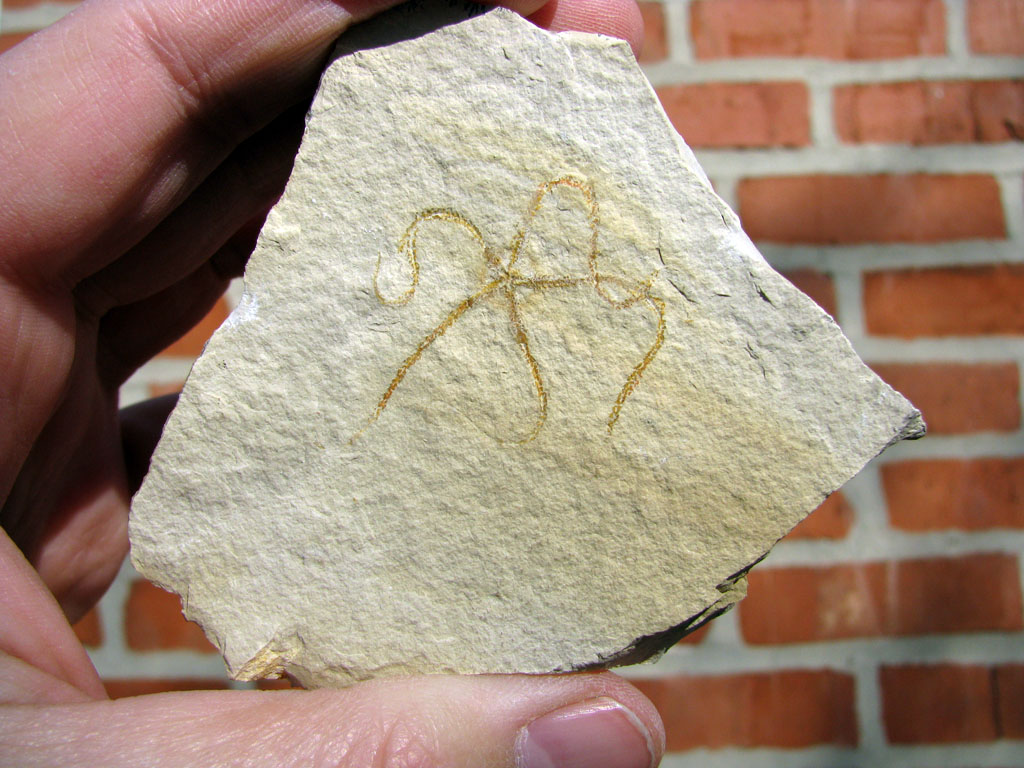
These next two fossils are legitimate starfish that both come from the famous quarries around Solenhofen, Germany. The rocks that yield these fossils are dated to the Tithonian stage of the Jurassic. Both look very similar to each other but it seems that Sinosura kelheimense has thinner arms than Ophiopetra lithographica.

Sinosura kelheimense


Ophiopetra lithographica


Thanks to Gery for the first two fossils.

Monday, February 10, 2014

Fossil branch from the Mahantango

Being that the Mahantango formation is Devonian in age, more specifically Givetian stage, it is not uncommon to find pieces of pyritized branches. Sometimes they can be a bit difficult to ID as fossil wood because they are thin and often could be confused with worm burrows. On a recent trip to Deer Lake, PA I found a piece with what I believe is unmistakably a fossil branch. On the specimen below you can see the brown-orange staining from the breakdown of the pyrite which is the first clue.

Next is this closeup which shows a branching structure that could be the remains of a rachis (central vein to which the pinnules of leaflets were attached in tree ferns).
Lastly is the patten of the preserved structure which is entirely different from the surrounding rock. It looks striated and rough where as the rock is smooth and homogenous.
I could still be wrong and this is actually a worm burrow. There are no other preserved "rachis" which should be regularly spaced along a main branch. On the other hand the fossil is very straight with no obvious undulations that might be the result of the worm moving through the sediment.

No matter what this is an interesting specimen and makes one think about the paleoenvironment that it was deposited in.

Saturday, November 3, 2012

Starfish Traces from France

What looks like a starfish fossil is, in fact, a trace fossil. It represents where a starfish burrowed into the sediment to hide and rest or in search of prey. This fossil comes from the middle Jurassic (Callovian stage) from La Voulte-sur-Rhône in France. This site is considered a Lagerstatte due to the fine preservation of echinoderms like starfish, brittlestars, crinoids etc. along with many other animals where the soft tissues have been preserved by pyrite or phosphate.


This fossil was sent to me by my friend Gery in France.

Here's a link to the Wikipedia page about the locality.

This website has some of the actual starfish fossils for sale.

Sunday, May 6, 2012

Ophiomorpha nodosa from the Navesink formation

A common find in the brooks of Monmouth county, NJ are these preserved burrows called Ophiomorpha nodosa. They are the former homes of a species of Ghost shrimp often attributed to the genus Protocallionassa. These are technically trace fossils and not true fossils but they are interesting none the less.


The Navesink was lain down in the latest Cretaceous (Masstrichtian stage) as a layer of sediment that was (at that time) moderately deep water.

Thursday, April 26, 2012

Trypanites borings in a Prasopora bryozoan from the Verulam Fm.

While sorting through some fossils from the Verulam formation, in preparation for a display I was putting together for the DVPS show, I found this specimen of Prasopora with boring marks these holes. The holes are indications of a trace fossil called Trypanites. It's fairly common in hard carbonate substrates( like hardgrounds, corals and shells) and is the result of some kind of burrowing animal.


The animal would bore into the carbonate and make it's home there but has not left any other traces of what it was. Possibly it was a boring sponge, like Cliona, or a worm which had no hard parts.

Friday, March 23, 2012

Conostichus trace fossils

Today I have some odd trace fossils to show you. They are called Conostichus and come from the Pennsylvanian rocks of Texas. Most often found as conical shaped masses of sediment Conostichus are thought to represent the infilling of a burrow of some sort.


These were some odd fossils and I know very little about them and what they were. I posted pictures of these oddball fossils to the Fossil Forum to see if anyone could help me out. I got a lot of good responses especially from my friend Barry (Indy is his forum name) who pointed out that:

Conostichus (a fossil with a confusing history) was formerly thought to be a jellyfish resting trace. It is now regarded as a burrow infilling or feeding structure of an unidentified organism. These fossils were first described by Lesquereux in 1876 as a marine algae and then by later authors
as roots, stems, sponges or worms. C.C. Branson wrote a number of articles circa 1956/1962 in which he discusses numerous separate species. In a 1959 article he states "It is possible to state at this time that the genus Conostichus has but one species, C. ornatus; that some of the marine specimens may be medusoids; that some of the types are probably marine worms. Close examination of specimens in place in the rock and of the associated biota is necessary to a real understanding of these four similar types of fossil." In later articles he describes a number of new species. Joeckel, 2008 states "A trace-fossil hypothesis for the origin of the structures remains plausible...possible feeding structures---albeit problematic".
Barry is a smart guy and has his own website filled with good reading about his local rocks in the Missouri area at Paleontology and Geology of Missouri.

Here is another specimen of Conostichus that shows a slightly different shape and structure.


I don't have much locality info to go on with this specimen. All I could find with the label was "Pennsylvanian" and "Texas". I think it might be from the Finis Shale but I can't be sure.

Tuesday, June 8, 2010

Skolithos

This is a piece of Quartzite with Skolithos trace fossils present. Skolithos is the name given to the thin vertical tubes that you can see running from the bottom to the top of the rock. This type of trace fossil is not uncommon in the geologic record and is known to occur in sediments from the Cambrian up to the present day.


This particular piece of rock comes from the Montalto Member of the Harpers Formation of York county in Pennsylvania. It's interesting due to the fact that an ancient surface of the sea floor has been preserved and you can see the tops of the tubes. They look like small ovals carved into the rock and probably represent a sediment mound that was created as the animal moved in and out of the tube to feed. Nobody knows exactly what kind of animal created these traces but the going theory is some kind of worm.


Some of you may ponder the notion that I found these fossils in a Quartzite which is a metamorphic rock formed from Sandstone that was transformed under immense pressure and temperatures. In fact the formation this rock came from has been dated to the early Cambrian (542 mya to 520 mya). It is thought to represent an active beach environment with wave action much like the intertidal areas on today's beach.

Often you won't find fossils in metamorphic rocks because the processes involved will up destroy them. Sometimes fossils will be found, however, in rocks that have undergone the process but were not involved in a lot of movement. For example, take a couple of individual cake layers and put a design on one of them. Then stack the other cake on top of the one with the design and press down, thus representing the pressure the rocks undergo. If you don't move your hand around much then the design will be intact. If, however, you push down and then slide the two layers across one another and then fold them over you will destroy the design. In the case of this example the rock was transformed by pressure and heat forcing the quartz grains closer together and recrystallizing some but without pushing the grains around, thus preserving the Skolithos tubes.

Here is another example of Skolithos tubes from the Antietam formation. The rock is a lighter color than that from the Montalto Member but was probably formed the same way and is a little younger in age.