Showing posts with label Navesink Formation. Show all posts

Wednesday, August 14, 2013

Belemnitella americana cepholopod from New Jersey

One of the most common fossils found in the Cretaceous sediments of New Jersey and Delaware are the cigar colored and shaped guards (rostra) of Belemnitella americana. They are called guards but were actually internal supports/skeletons of the animal. B.americana belonged to a group of squid like creatures called Belemnites that have relatives in the modern cuttlefish. When they existed during the Jurassic and Cretaceous they were prolific and sometimes formed massive shoals with their skeletons. Belemnitella americana is the state fossil of Delaware.

Here is an example of a nearly complete specimen that I found. It was broken into two pieces that I glued back together. The next few pictures show the guard rotated every 90 degrees towards the camera.


This is the very end of the rostrum and should narrow down to a tip but that is missing from this specimen.
Here is a view of the living chamber where the phragmocone would have been and the internal organs of the animal were stored.
Another view to show you the depth of the chamber.

Speaking of the phragmocone, below is a specimen that retains this feature. The phragmocone was the equivalent of the ammonites curled shell. Each band represents a period of growth and if one looked carefully enough at the very tip there would be a protoconch. The guard was a skeleton that was deposited around the phragmocone rather than a shell like in ammonites.
Some of the guards were left exposed on the sea floor for long enough time to be colonized by other animals. Here a bryozoan colony grew on a guard and then later had some Spirorbis worms build their homes on top of them.

All specimens come from the Navisink and Mt. Laurel formations of New Jersey in Monmouth County, NJ. The formations record the very end of the Cretaceous in the Campanian and Maastrichtian stages.

These are the first American Belemnites I've shown with prior posts showing specimens from Poland and Sweden.

Monday, August 12, 2013

Ostrea falcata pelecypod from New Jersey

Up for viewing today are a couple of Ostrea falcata fossil oysters from the Cretaceous of New Jersey. These are uncommon fossils that I found in the Navesink formation exposed along Big Brook in Monmouth County, NJ. There is a layer where these are found in more abundance that could represent a storm deposit or possibly a calm period which allowed colonization of the seafloor. This species is very similar looking to the more common Ostrea mesenterica (that I'll post about later) but O. falcata has obvious surface ornamentation.

Left valve
Anterior
Left profile
Posterior
Right profile
Right valve

Here is a second specimen: Left valve
Anterior
Left profile
Posterior
Right profile
Right valve... Note the bore hole made by a predatory snail.

I also have a steinkern of a much larger specimen of O. falcata that came from the C&D canal in Delaware. I purchased it at a show put on by the Delaware Mineralogical Society.

Left valve
Right valve
Anterior
Left profile
Posterior


All the above specimens come from the Masstrichtian stage of the Cretaceous when New Jersey and Delaware were submerged under the Atlantic Ocean and Philadelphia was beachfront property.

Friday, May 18, 2012

Protocallinassa sp. claw from the Navesink formation

As a companion piece to the Ophiomorpha nodosa burrows I posted last week, here is a partial claw from the arthropod that lived in the burrows. It's called Protocallinassa and was a ghost shrimp that lived on the seafloor scavenging for food. It's not too commonly found as the exoskeletons often fell apart in the water current after death.


I found this fossil at Big Brook near Marlboro, Monmouth County, NJ. It probably came from the Navesink formation (Cretaceous, Masstrichtian stage)which lines the banks of the creek.

Thursday, May 10, 2012

Anomoeodus phaseolus tooth from the Navesink formation

Anomoeodus phaseolus was a species of Pycnodontid fish (shell crushers which lived during the late Cretaceous. It is somewhat common within the sediments of the Navesink formation (Maastrichtian stage) and is easily found in the brooks and creeks of Monmouth County, NJ. The specimen below was found in the Ramanessin creek near Holmdel, NJ.

The top or grinding surface
Side view
Underside, note the hollow nature of the tooth.
Profile

Anomoeodus replaced their teeth much like sharks do with old, worn ones falling out and replacements growing in. This would explain their common nature and often worn look. They typically preyed on invertebrates like shrimp, crabs and oysters. They possibly nibbled at epifauna on the surface of oysters and other hard sea floor surfaces as well.
Check out more pics and info at Oceans of Kansas which has many other species of Pycnodontid fishes.

The website Fossils of NJ has a nice page of specimens found in Monmouth County, NJ

Tuesday, May 8, 2012

Hybodont shark spine from the Navesink formation

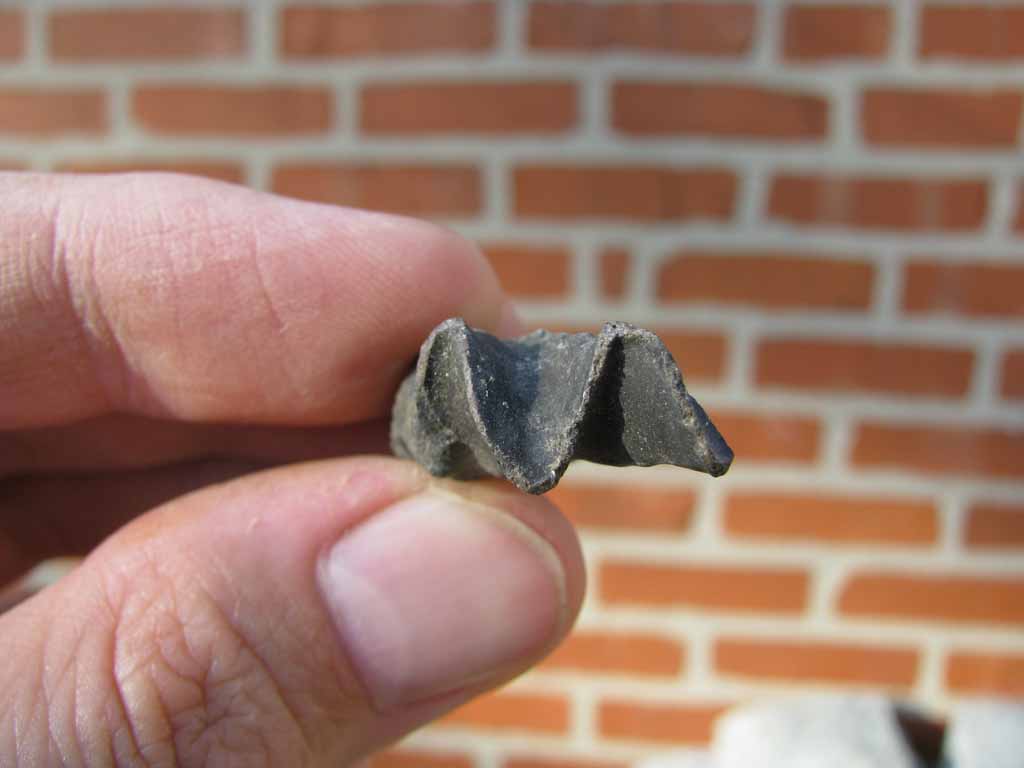
This fossil was an odd one for me when I found it. It's a spine from a Hybodont shark but at first I thought it was a tooth from some sort of shell crushing fish or shark. It's a U shaped piece of bone with some small bumps along the surface. This was found at Big Brook near Marlton, NJ and comes from the late Cretaceous (Maastrichtian stage) aged sediments of the Navesink formation.
The fossil was delicate after I first found it and I had to repair a couple of breaks like the one you can see below.....
and along the ridge between the two sides.


The spine was on the exterior of the Hybodont sharks dorsal fin and ran along the front edge. Apparently it was used for defensive purposes.

Here is a good page from NJfossils.net which talks about Hybodont sharks and the material that can be found at Big Brook in Monmouth county near Marlboro, NJ.

Sunday, May 6, 2012

Ophiomorpha nodosa from the Navesink formation

A common find in the brooks of Monmouth county, NJ are these preserved burrows called Ophiomorpha nodosa. They are the former homes of a species of Ghost shrimp often attributed to the genus Protocallionassa. These are technically trace fossils and not true fossils but they are interesting none the less.


The Navesink was lain down in the latest Cretaceous (Masstrichtian stage) as a layer of sediment that was (at that time) moderately deep water.

Friday, May 4, 2012

Hoploparia gabbi from the Navesink formation

Hoploparia gabbi is a lobster that is found in the Navesink formation of New Jersey. I found it in the Ramanessin creek near Marlboro, NJ. This is only a partial fossil of the whole animal as it's missing the legs, claws and tail but it's still fairly rare to find even this much.

Ventral (top) surface
Left side (Anterior to left)
Right side (anterior to right)

The Navesink was lain down in the latest Cretaceous (Masstrichtian stage) as a layer of sediment that was (at that time) moderately deep water.

Monday, April 30, 2012

Pyncnodonte convexa from the Navesink formation

One of the most common shells that is found within the Navesink formation in New Jersey is Pycnodonte. There are a couple of species with the one I'm showing you today being a Pyncnodonte convexa. It was found at Big Brook near Marlboro, New Jersey in the Navesink formation which is upper Cretaceous (Maastrichtian stage) in age.

Left valve top

Left valve anterior

Left valve, right side profile

Left valve interior

Left valve, left side profile. Note the worm tube that is embedded in the shell.

Left valve posterior

Here are a couple of the right valves which are smaller than the left valve and slightly convex.

Right valve top

Right valve interior

Right valve posterior

Right valve profile

Shells of these oysters are often colonized by epibonts such as sessile worms, sponges and bryozoans. You can see some Bryozoans that have colonized the gaps in the right valve shell below.


Here is a closer view of the worm tube that I indicated above: