Showing posts with label Gamebridge. Show all posts

Thursday, July 2, 2020

Mystery echinoderm from the Verulam formation

Below are some pictures of a mystery Echinoderm from the Verulam/Bobcaygeon formation. I am not entirely sure of the formation this comes from as it was found in an area that was close to the boundary of the two units.

It was found a couple of years ago and cleaned by an expert but there it not much there to go on. I posted these images to a group on Facebook that is frequented by knowledgeable people who have collected for many years from the Verulam and Bobcaygeon formation. The only possibility that was suggested was that it could have been part of the central body of a starfish. The presence of many small plates does make it seem like an echinoderm and starfish have lots of small plates as part of their bodies so I think this is as close as I'll be able to get to figuring out just what this was. For reference, the fossil is about the size of a US quarter.


I collected this fossil in 2017 at the James Dick quarry near Gamebridge, Ontario. The Verulam and Bobcaygeon formation is late Ordovician in age, Katian/Mohawkian stage.

Monday, June 29, 2020

Ceraurus globulobatus Trilobite from the Verulam formation

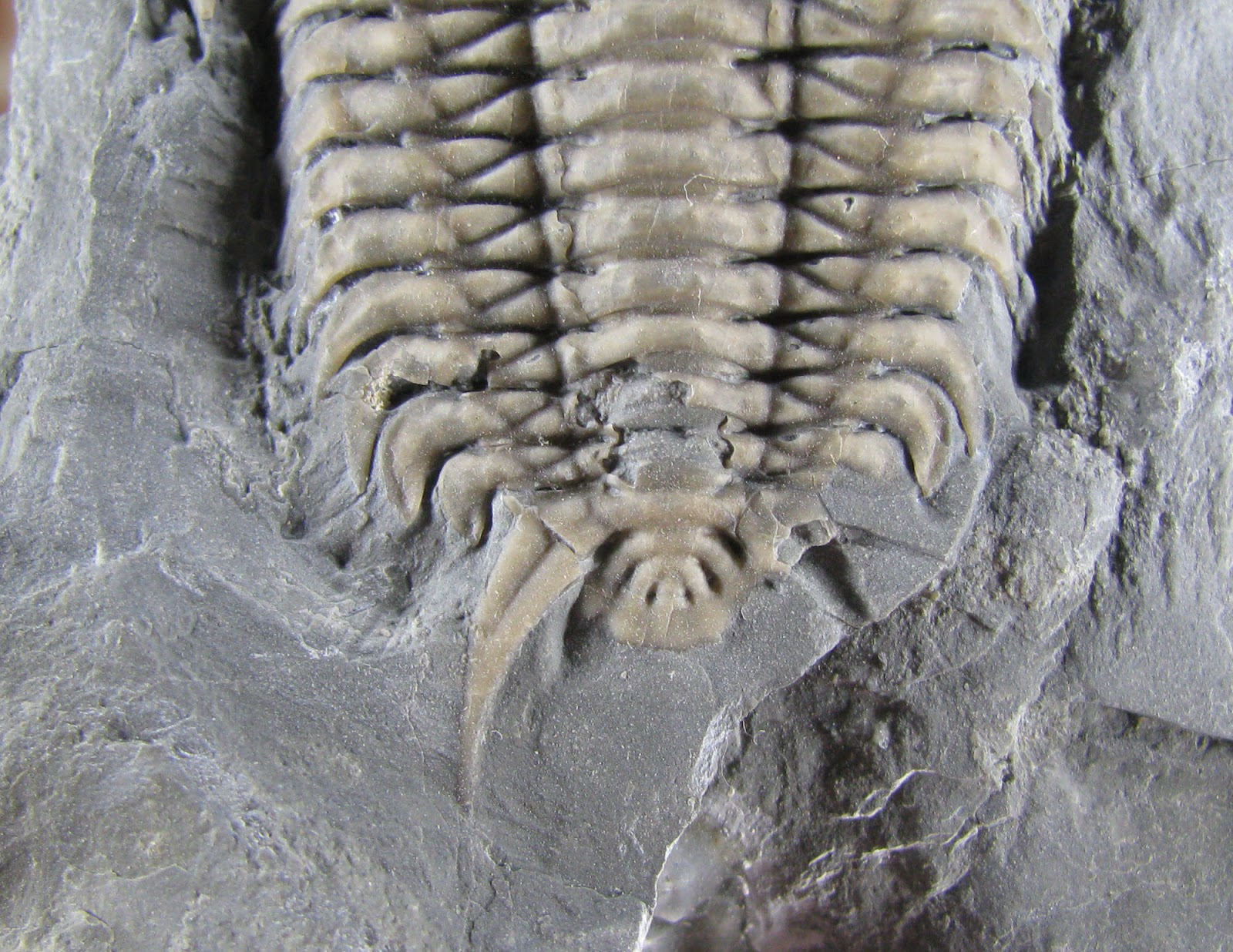
I've mentioned before that I don't often have luck with finding Trilobites, well the specimen below is a definite exception to the rule. It's a Ceraurus globulobatus from the Verulam formation. I found it a few years back and a friend, M.T., did the prep work to clean it up. It's not a perfect specimen but it's darn nice. The glabella is slightly crushed and one of the tail spines is missing as well as a small section of shell from the end of the thorax. All in all though, it's a large fossil and a species I never had before.


It is a very flat specimen so perhaps more evolved to swim in the water column?

The eyes are fairly well preserved and not crushed. I am not able to see any lenses though.

Here is what it looked like before it was cleaned up.


I collected this fossil in 2017 at the James Dick quarry near Gamebridge, Ontario. The Verulam formation is late Ordovician in age, Katian/Mohawkian stage.

Friday, June 26, 2020

Cupulocrinus jewetti crinoid from the Bobcaygeon Fm.

This is a partial Crinoid from the Bobcaygeon formation in Gamebridge, Ontario, Canada. I found it a few years ago on a field trip and a friend, Malcolm, cleaned it up for me. The crinoid is named Cupulocrinus jewetti and this is a pretty good example. The stem and some arms are missing but otherwise it is a decent specimen.  It is one of the few articulated crinoid specimens that I have found myself.


The Bobcaygeon formation is Ordovician in age (late Ordovician, Katian/Mohawkian stage).
I used William Hessin's book "South Central Ontario Fossils", 2009, Self Published, pg. 244 to help identify this fossil.

Wednesday, June 24, 2020

Syringocrinus paradoxicus carpoid plate from the Verulam formation

A number of years ago I picked up a large plate of shaly limestone at the James Dick quarry in Gamebridge, Ontario. It comes from the Verulam formation and I knew it was a special find as I could see what looked like crinoid stems on it but with slightly different shapes to the stems. It turns out that after a good cleaning by my friend Malcolm the crinoid stems are actually carpoid stems. Carpoids are odd echinoderms that are cousins to crinoids. These particular fossils are called Syringocrinus paradoxicus and are fairly rare to find. There are no complete specimens on the plate but plenty of stems and calyx plates scattered about. 


As a bonus, there is a small Archaeocrinus sp. crinoid off to one side of the plate. Thanks go out to Kevin B. for the ID on this small fossil (the calyx is maybe 1cm in width).


The Verulam formation is Ordovician in age (late Ordovician, Katian/Mohawkian stage).

Monday, December 29, 2014

Geniculograptus typicalis graptolite from the Verulam formation

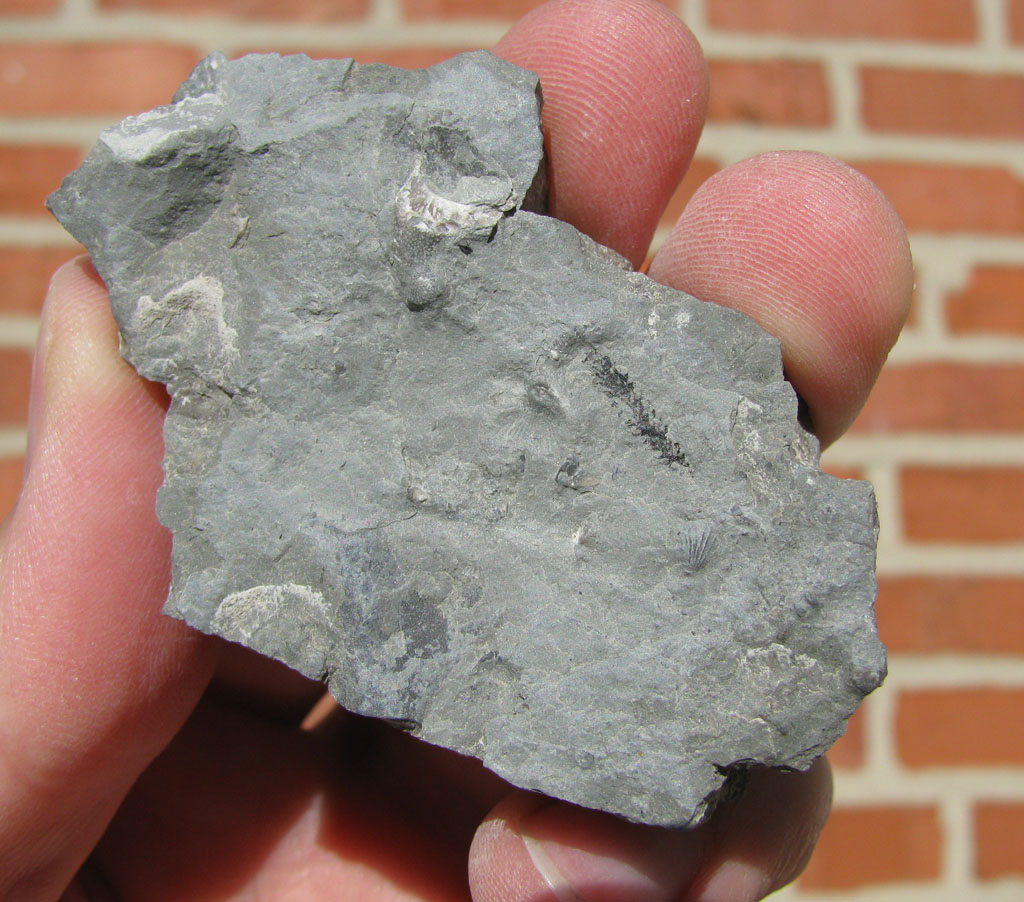
Of the two Graptolites that are common in the Verulam formation (middle Ordovician, Katian/Mohawkian stage)of Ontario, Climacograptus typicalis Geniculograptus typicalis is by far the most common. I've found several pieces of it during my many visits but none are very well preserved. Climacograptus Geniculograptus typicalis can be distinguished from the similar looking Diplograptus by the upturned "teeth" along the sides of the colony.

Specimen #1


Specimen #2


I found some better preserved examples of this species near Lusters Gate in Virginia.

Edit 1/4/15 - It has come to my attention that the species Climacograptus typicalis has since been renamed to Geniculograptus typicalis, Thanks to the person who runs the "Dry Dredgers" handle on Facebook. They also provided the following: "Mitchell (1987, p. 381; PDF here: http://www.palass-pubs.org/.../pdf/Vol30/Pages%20353-405.pdfused *Climacograptus typicalis* Hall, 1865 as the type species of his new genus *Geniculograptus*. Subsequent authors have supported the validity of *Geniculograptus* and it's been used in graptolite publications as recent as one or two years ago (e.g. Cooper et al 2012; PDF here: http://www.researchgate.net/.../file/3deec527ea87992c1f.pdf

Saturday, December 27, 2014

Diplograptus amplexicaulis graptolite from the Verulam formation

Graptolites are a colonial organism similar to Corals and Bryozoans and they are also important index fossils used to help date the rocks they are found in. In the Verulam formation (middle Ordovician, Katian/Mohawkian stage) of Ontario, Canada they are found as black carbon films on the grey limestone rock. Below is Diplograptus amplexicaulis, one of two species that is known from the formation. It formed straight, needle like colonies with edges that look like a saw tooth. Each of the "teeth" was an individual animals home and the colony grew by budding at the tip to make the whole group longer. Because the fossils are preserved only as carbon films it is hard to get good clear examples as they flake or rub off very easily.

Specimen #1


Specimen #2