Corals are not terribly common in the section of the Kalkberg formation that I have collected and most of what I have found are small examples. Such is the case with Favosites heldergeriae as seen in these two examples that are about the size of a US quarter.
This first specimen has a small mound starting in the center and is spreading out.
A side view
When it is flipped over you can see the epitheca which is slightly wrinkled. The most notable feature of the ventral side of this fossil is the odd checkerboard pattern. Obviously the coral settled upon something and then recorded a negative impression of the surface as it grew.
This is a strange looking impression and one that I was not able to readily identify myself. It is a regular, pattern of squares that appear to taper to points like very shallow pyramids. I posted pictures to Facebook in the Devonian group and the consensus was that it was an impression from a calcareous algae called Receptaculites sp.
I did a little more digging and found that Hall lists Recepticulites infundibuliformis (=Recepticulites monticulatis) in Paleontology of NY, Vol 6, pg 289, pl. XXIV fig. 3-11 as coming from the lower Helderberg. Also I found a paper by John W. Wells in the Journal of Paleontology Vol. 30, No. 3 (May, 1956), pp. 747-748 that discusses a Recepticulites found in Upper Devonian strata of NY near Cornell: http://www.jstor.org/discover/10.2307/1300307
So the coral colonized a hard surface that happened to be part of a Recepticulite (expired?) colony and preserved an impression of the surface. That is pretty cool in my book!
Here is a second, smaller specimen of F. helderbergiae but, alas, the ventral surface is not well exposed so I can't see if there is an impression of what it colonized on the epitheca.
Finally, I have a larger example to show you. I think it is a F. helderbergiae but it could also be F. conicus which is also known from the Kalkberg formation.
All the above specimens come from the Devonian aged (Lockhovian to Pragian stage) Kalkberg formation. I found them in a roadcut near Schoharie, NY.
Monday, August 10, 2015
Saturday, August 8, 2015
Leptaena rhomboidalis brachiopod from the Kalkberg formation of New York
When you compare the previous brachiopod I posted about, Rhytistrophia beckii, to today's fossil, Leptaena rhomboidalis there are some key differences. Both are large shells that are semiellipical (half moon shaped) to subquadrate (nearly square) with straight hinge lines. The valves of both shells are nearly flat but the margin of the shell in L. rhomboidalis is turned 90 degrees from the regular shell surface all along the edge. Another distinguishing feature is the somewhat regular, concentric wrinkles or corrugation of the shell which was only weakly expressed in R. beckii. This fossil is more common than R. beckii based on the number of specimens I found.
Pedicle valve
Anterior - note the wall like appearance of the shell and how it turns at a sharp angle.
The brachial valve is covered with matrix but you can see part of it exposed in the upper left and some of the margin where the shells meet.
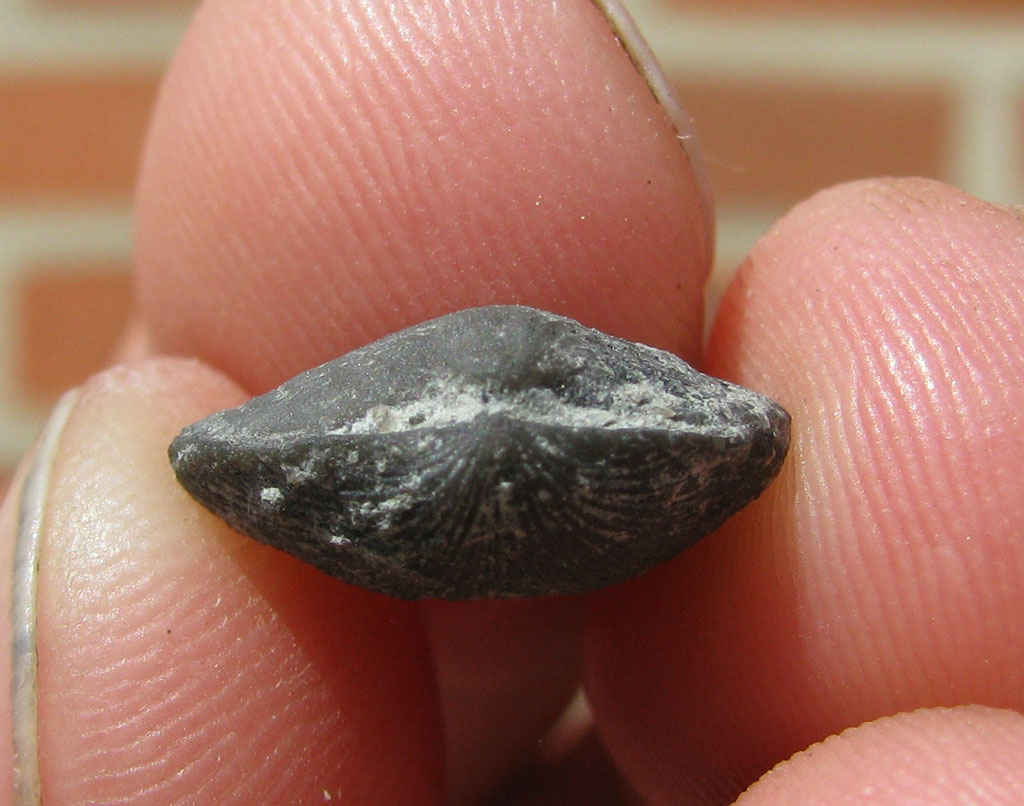
Profile - When viewed from the side, L. Rhomboidalis has a profile like that of an obtuse triangle.
Posterior
Here is a specimen of the brachial valve that shows the interior.
These specimens comes from the Kalkberg formation which is Devonian in age (Lockhovian to Pragian stage) and was found in a roadcut near Schoharie, New York.
Pedicle valve
Anterior - note the wall like appearance of the shell and how it turns at a sharp angle.
The brachial valve is covered with matrix but you can see part of it exposed in the upper left and some of the margin where the shells meet.
Profile - When viewed from the side, L. Rhomboidalis has a profile like that of an obtuse triangle.
Posterior
Here is a specimen of the brachial valve that shows the interior.
These specimens comes from the Kalkberg formation which is Devonian in age (Lockhovian to Pragian stage) and was found in a roadcut near Schoharie, New York.
Thursday, August 6, 2015
Rhytistrophia beckii brachiopod from the Kalkberg formation of New York
Another tough fossil brachiopod for me to identify is the one shown below. At first it looked like a Leptanea sp. but the shell is not rectangular enough. Then I thought it might be a Strophomena sp. but I've not seen one that has the "corrugated" surface. Finally I settled on Rhytistrophia beckii after reading the description in Karl Wilson's book "Field Guide to the Devonian Fossils of New York" on page 79:
A search of the name Rhytistrophia beckii on the Fossilworks.org website, lists the name as one of several "alternative combinations" along with Leptostrophia beckii and Strophomena (Strophodonta) beckii. In Hall's 1861 "Paleontology of New York" Vol 3 (pg. 191, fig. 22) it is known as Strophodonta beckii.
The shell is embedded in the matrix still so I'm not sure if it's a single valve or has both. The white mark is some damage the fossil took when it tumbled down the cliff face.
An attempt at an anterior view of the fossil
This is the hinge line which is visible on the very back edge of the rock.
This fossil was collected from the Kalkberg formation (Devonian, Pragian to Lockhovian stage) near Schoharie, New York.
Large, semielliptical or subquadrate shell; both valves nearly flat. Surface with strong, regular, closely arranged radial striae, fine concentric growth lines, and some more-or-less concentric wrinkles.
A search of the name Rhytistrophia beckii on the Fossilworks.org website, lists the name as one of several "alternative combinations" along with Leptostrophia beckii and Strophomena (Strophodonta) beckii. In Hall's 1861 "Paleontology of New York" Vol 3 (pg. 191, fig. 22) it is known as Strophodonta beckii.
The shell is embedded in the matrix still so I'm not sure if it's a single valve or has both. The white mark is some damage the fossil took when it tumbled down the cliff face.
An attempt at an anterior view of the fossil
This is the hinge line which is visible on the very back edge of the rock.
This fossil was collected from the Kalkberg formation (Devonian, Pragian to Lockhovian stage) near Schoharie, New York.
Tuesday, August 4, 2015
Vermipora serpuloides coral from the Kalkberg formation of New York
Here we have a strange looking coral that was found in the Kalkberg formation. It resembles cross between a stick coral and an auloporid type coral. The closest match I can find for this is Vermipora serpuloides which I found in the "Palaeontology of New York", Vol. 6, pg. 5, plate ii, fig 24-31:
And here is a screen grab from the .pdf file that is linked above.
I only have one piece of this odd coral.
This closeup shows the rambling nature of the corallites and how they look like worm tubes, thus the generic name.
This specimen was collected from a roadcut near Schoharie, NY in the Kalkberg formation (Devonian, Lockhovian to Pragian stage).
Corallum ramose, consisting of continuous serpula-like cell tubes, without
intercellular tissue, arising from the center of the branch, and increasing by
lateral gemmation. No transverse diaphragms or mural pores have been
observed in the typical species of the genus.
I only have one piece of this odd coral.
This closeup shows the rambling nature of the corallites and how they look like worm tubes, thus the generic name.
This specimen was collected from a roadcut near Schoharie, NY in the Kalkberg formation (Devonian, Lockhovian to Pragian stage).
Sunday, August 2, 2015
Orthis? sp. brachiopods from the Kalkberg formation of New York
I'm really torn on how to classify these next fossils from the Kalkberg formation. To my eye they look like Rhipidomella sp., which is very common in middle Devonian aged rocks, but I cannot find any literature that lists that genus as being found in the Kalkberg formation. What I have been able to find lists shells that look similar to these as belonging to the genus Orthis. Doing a little research on the Fossilworks.org website indicates that both Rhipidomella and Orthis are part of the same order, Orthida, but they diverge into separate families from there. It may be that minute details of the internal structure is what differentiates them from one another,
Here are two different specimens that show the size range of these brachiopods.
The smaller specimen is more complete so I will profile that for this post. This is the Brachial valve
Anterior
Pedicle valve
Posterior
Profile - note that in the profile, the anterior appears to be nearly flat. In some specimens of both Rhipidomella and Orthis, species can be differentiated if the pedicle valve sticks out beyond the margin.
These specimens were collected from the Kalkberg formation (Devonian, Lockhovian to Pragian stage) in a road cut near Schoharie, NY.
Here are two different specimens that show the size range of these brachiopods.
The smaller specimen is more complete so I will profile that for this post. This is the Brachial valve
Anterior
Pedicle valve
Posterior
Profile - note that in the profile, the anterior appears to be nearly flat. In some specimens of both Rhipidomella and Orthis, species can be differentiated if the pedicle valve sticks out beyond the margin.
These specimens were collected from the Kalkberg formation (Devonian, Lockhovian to Pragian stage) in a road cut near Schoharie, NY.
Subscribe to:
Posts (Atom)