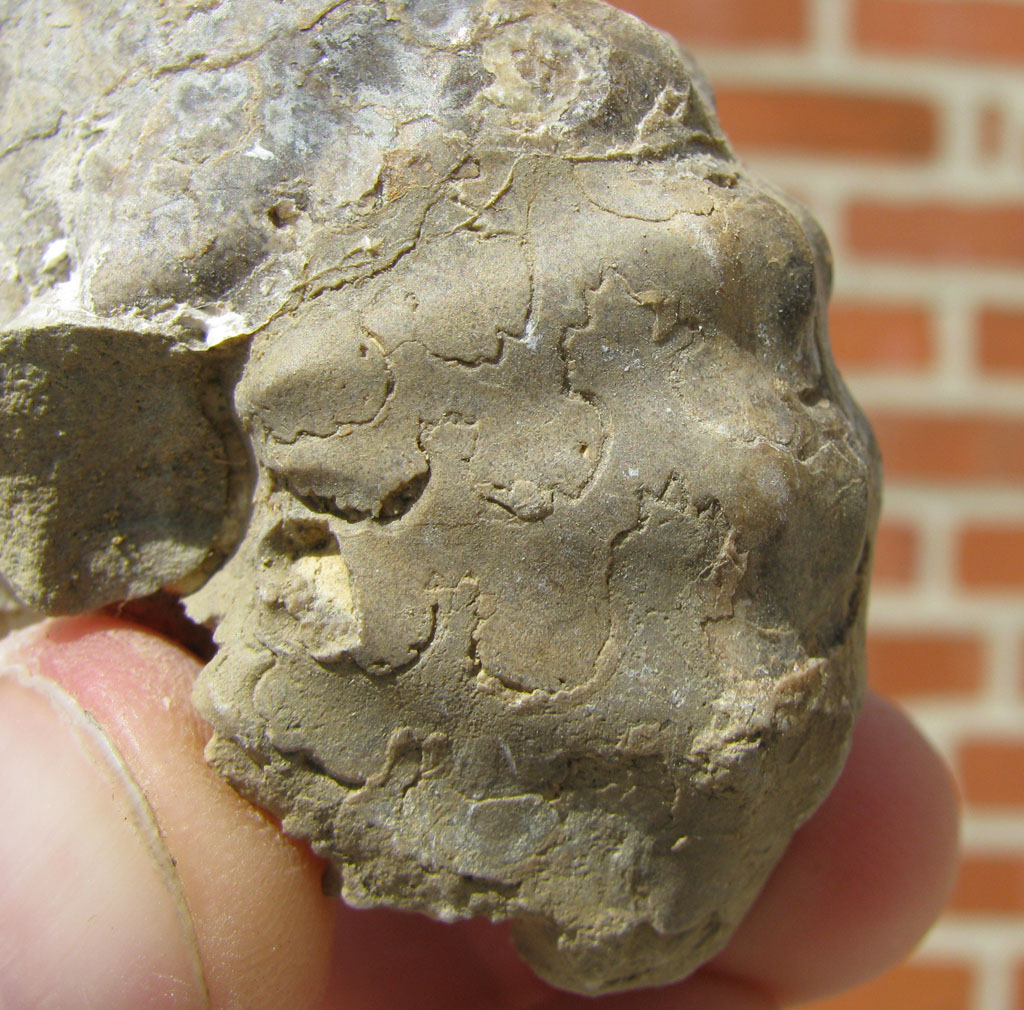
Here are another couple of Ammonites from the Carlile shale member of the Mancos Shale (Turonian stage of the Cretaceous) of Sandoval County, New Mexico. They are specimens of Spathites puercoensis. This ammonite is small but somewhat robust with some obvious ribs near the keel. Each whorl overlaps the previous by about 95%. As these are steinkerns and no original shell is left, the suture pattern is easily visible and consists of a number of alternating "U" shapes, of differing depth, accented with some smaller zigzags.
Specimen #1
Right side
Left Side
Keel
A cross section view of the last suture chamber
Specimen #2
Left side
Right side (note the rock plug in the center which indicates there were likely more whorls that eroded away before the fossil was found)
Keel
Cross section view of the last suture.
A closer view of the suture pattern.
The publication "Contributions to Late Cretaceous Paleontology and Stratigraphy of New Mexico Part II". Bulletin 114. New Mexico Bureau of Mines and Mineral Resources. contains a paper by W. A. Cobban titled "The Late Cretaceous ammonite Spathites Kummel and Decker
in New Mexico and Trans-Pecos Texas" from which this illustration of the suture patterns of S. puercoensis comes.
Thanks to Mike (PFooley on the Fossil Forum) for this fossil that he offered up as part of an auction to help defray some of the operating costs of the Fossil Forum website.
Showing posts with label Carlile member. Show all posts
Friday, July 29, 2016
Tuesday, July 26, 2016
Coilopoceras springeri ammonite from the Mancos Shale of New Mexico
Today I have an Ammonite from New Mexico to show you. It's a Coilopoceras springeri from the Carlile Shale member of the Mancos Shale (Turonian stage of the Cretaceous), Sandoval County, NM. The fossil is very thin in cross section, it reminds me of a frisbee, and has a very complex suture pattern. Each whorl overlaps the previous whorl by about 95%.
Right side
Left side
Keel
A closer detail of the keel from the side. I'm not sure if the segmentation that is shown is part of the shell or just an erosional feature.
Keel with a cross section view of the last suture chamber.
A closer view of the suture pattern.
I found a publication, "The Upper Cretaceous (Turonian) ammonite family Coilopoceratidae Hyatt in the Western Interior of the United States." W. A. Cobban and S. C. Hook. 1980. United States Geological Survey Professional Paper 1192:1-28, that has a good description of this species and this helpful drawing (figure 11, page 18) of a few typical suture patterns from C. springeri specimens.
Thanks to Mike (PFooley on the Fossil Forum) for this fossil that he offered up as part of an auction to help defray some of the operating costs of the Fossil Forum website.
Right side
Left side
Keel
A closer detail of the keel from the side. I'm not sure if the segmentation that is shown is part of the shell or just an erosional feature.
Keel with a cross section view of the last suture chamber.
A closer view of the suture pattern.
I found a publication, "The Upper Cretaceous (Turonian) ammonite family Coilopoceratidae Hyatt in the Western Interior of the United States." W. A. Cobban and S. C. Hook. 1980. United States Geological Survey Professional Paper 1192:1-28, that has a good description of this species and this helpful drawing (figure 11, page 18) of a few typical suture patterns from C. springeri specimens.
Thanks to Mike (PFooley on the Fossil Forum) for this fossil that he offered up as part of an auction to help defray some of the operating costs of the Fossil Forum website.
Subscribe to:
Posts (Atom)

