Showing posts with label Haragan formation. Show all posts

Saturday, June 13, 2020

Cyphaspis carrolli trilobite from the Haragan formation

The lower Devonian rocks of Oklahoma are full of really cool trilobites and I've had a chance to collect some from the Bois D'Arc formation. The Haragan formation is stratigraphically similar and  is mined by Bob Carroll for the trilobites that it contains. He has been mining for decades and doing his own prep work of the majority of his finds. When I saw this specimen of Cyphaspis carrolli (named for Bob) for sale I had to add it to my collection.

It's a small trilobite with raised eyes and spines coming off each side of the cephalon as well as one off the middle of the thorax. The specimen has been expertly prepped by Bob and looks like it is just resting before moving on.


The Haragan formation is Devonian in age (Lockhovian stage). The Bois d'Arc and Haragan formations interfinger with each other and are roughly the same age (Devonian, Lockhovian stage). They are both roughly correlative to the Helderberg fauna of New York and thus are contemporaneous with the Coyemans, Kalkberg and New Scotland formations.

Sunday, July 7, 2013

Paciphacops logani from Oklahoma

The trilobites that come out of the Haragan formation at Black Cat Mountain are amoung the worlds best. One of the more common species is Paciphacops logani. Below are several specimens I purchased at a local fossil and mineral show. The first three specimens I have since traded away to other collectors but the last specimen is still with me.

Specimen #1


Specimen #2


Specimen #3 - This piece has two trilobites on it and almost stayed with me because of the arrangement.


Specimen #4 - This is my favorite because of the association with a Rhynconellid type (likely a Stegerhynchus sp. based on the shell shape and over hanging pecidle) brachiopod.


All four specimens came from the Haragan formation at Black Cat Mountain near Clarita, OK. the Haragan formation is thought to be lower Devonian, (Lochkovian stage). It roughly corresponds to the Birdsong shale of Tennessee and the Helderberg Fauna of New York, Pennsylvania and Maryland.

Friday, July 5, 2013

Platystoma sp. gastropod from the Haragan Formation

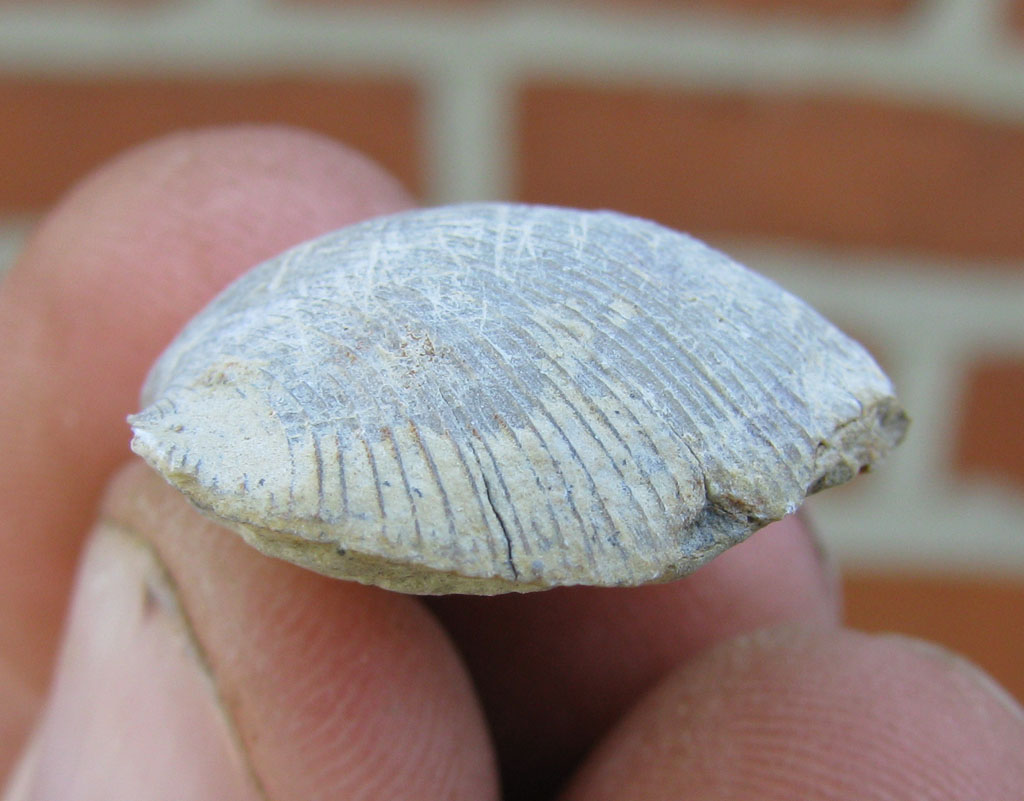
In the fossils from the Haragan formation that I have contains a particular type of Gastropod. Pictured below are a couple of examples. I have had a hard time trying to find any information on Gastropods from the Haragan formation but I believe these are Platystoma sp.
Specimen 1


Specimen 2


What I find interesting about the fossil is the way the shell grew rounded along the edges of each whorl rather than having direct contact. Then there the fact that some have a little bit of a spire (such as in specimen 2) while others are more flattened (as in specimen 1). In the Birdsong shale of Tennessee, which is though to be contemporary to the Haragan formation, there is a species called Platystoma ventricosa that looks very similar to the fossils above.

The Haragan formation is thought to be lower Devonian, (Lochkovian stage).

Saturday, May 11, 2013

Sphaerirhynchia brachiopod from the Haragan Formation

I have never had the chance to collect the Haragan formation myself and have received most specimens in my collection from purchases. Often I will buy lots of brachiopods with many different genera and included are fossils of Sphaerirhynchia sp.(which looks a lot like some specimens I see labelled Uncinulus sp.)

Here are a couple of examples:

Specimen 1
Brachial valve
Anterior
Pedicle valve
Posterior
Profile


Specimen 2
Brachial valve
Anterior
Pedicle valve
Posterior
Profile

A group of them in my hand.

Based on the book "Stratigraphy and Paleontology of the Hunton Group in the Arbuckle Mountain Region" by Thomas Amsden and Arthur Boucot, 1958, Oklahoma Geological Survey, (pg. 97-98, pl. VI) I'm going to call these Sphaerirhynchia lindenensis. There are several similar species notable S. glomerosa, Obturamentella wadei and Trigonirhynchia acutirostella, but trying to discern them from one another will require some more study.

The Haragan formation is thought to be lower Devonian, (Lochkovian stage). It roughly corresponds to the Birdsong shale of Tennessee and the Helderberg Fauna of New York, Pennsylvania and Maryland.

Friday, December 10, 2010

Stropheodonta gibbera

Stropheodonta (Hall 1852) is a common genera from the Silurian into the Devonian but the shell of this specimen is distinct enough to make a species ID. The specimen shown below is possibly S. gibbera based on the book "Stratigraphy and Paleontology of the Hunton Group in the Arbuckle Mountain Region" 1958 Thomas Amsden and Arthur Boucot, Oklahoma Geological Survey, Bulletin 78 pgs:73-75.


Pedicle Valve


Front


Brachial Valve (needs to be cleaned)


Rear


Profile


Note the highly convex nature of the Pedicle valve and how the sides seems to bend towards the tip like some kids do with the brims of their baseball caps. It's this growth feature that distinguishes the species. The species name come from the latin word "gibbera" which means hunchbacked and is also the root for the word "gibbous" that is often used to describe the phase of the moon just before or after a half moon.

This specimen came from an old estate collection of fossils that were collected in the 1960's to 1970's from the Haragan Formation at White Mound, OK. The Haragan formation is thought to range from the upper Silurain, 418mya, to the lower Devonian, 411mya ( Pridoli to Lochkovian). This would correspond to the Birdsong shale of Tennessee and the Helderberg Fauna of New York, Pennsylvania and Maryland.

Wednesday, December 8, 2010

Lavenea subcarinata pumilis

Levenea (Schuchert and Cooper 1931) has a look to it that reminds me of the Ordovician genus Dalmanella (Hall and Clarke 1892) and in fact this genus was once considered to be that. The specimen shown below is possibly L. subcarinata based on the book "Stratigraphy and Paleontology of the Hunton Group in the Arbuckle Mountain Region" 1958 Thomas Amsden and Arthur Boucot, Oklahoma Geological Survey, Bulletin 78 pgs:46-51.


Pedicle Valve


Front


Brachial Valve


Rear


Profile


This specimen came from an old estate collection of fossils that were collected in the 1960's to 1970's from the Haragan Formation at White Mound, OK. The Haragan formation is thought to range from the upper Silurain, 418mya, to the lower Devonian, 411mya ( Pridoli to Lochkovian). This would correspond to the Birdsong shale of Tennessee and the Helderberg Fauna of New York, Pennsylvania and Maryland.

Monday, December 6, 2010

Rhipdomelloides oblata

Rhipidomella (Oehlert 1890) is another common brachiopod from the Haragan Fm. as well as from the Silurian thru the Carboniferous. The book "Stratigraphy and Paleontology of the Hunton Group in the Arbuckle Mountain Region" 1958 Thomas Amsden and Arthur Boucot, Oklahoma Geological Survey, Bulletin 78; does not specify any particular species for these shells. Apparently at the time there was some discussion about how to classify the shells found in the Haragan and if they deserved a new genus based on thin sections of how the crenulations of the shells interlocked at the lip. Thanks to a fellow Fossil Forum member, I can now ID this as Rhipdomelloides oblata

Pedicle Valve


Front


Brachial Valve


Rear


Profile


This specimen came from an old estate collection of fossils that were collected in the 1960's to 1970's from the Haragan Formation at White Mound, OK. The Haragan formation is thought to range from the upper Silurain, 418mya, to the lower Devonian, 411mya ( Pridoli to Lochkovian). This would correspond to the Birdsong shale of Tennessee and the Helderberg Fauna of New York, Pennsylvania and Maryland.