Tuesday, August 16, 2011

Acrosalenia hemicidaroides

All Echinoids have spines attached to their exterior skeletons for protection or mobility. Often they are separated from the body after death but occasionally fossils can be found with the spines still articulated with the body. The plate below features such fossils with Acrosalenia hemicidaroides Echinoids and their spines preserved together.


Here is a single Acrosalenia hemicidaroides that is preserved with some Brachiopods. Note that there are spines present in the matrix around the Echinoid but that none are in life position like the above specimen.


These specimens come from Landville, France and are Jurassic (Bajocian) in age.

Sunday, August 14, 2011

A Slice of Heliophylum

I pick up a lot of Heliophylum corals on my collecting trips to Arkona and always wondered if the internal structure of the animal was preserved. My friend Mike over at Louisville Fossils was kind enough to cut one of the corals I found and I later polished it to reveal the details.

This side was closer to the outside edge of the coral and thus you see vertical lines that represent the septa (body support structures) of the coral.

This side was closer to the center of the coral and slightly different details are present. Note the curved regions near the edges. I believe these represent older calice positions. The calice is the "cup" at the top of the coral that the animals body would have occupied.

And a view of the cross section through the coral.

This specimen is from the Hungry Hollow member of the Widder formation, Middle Devonian (Givetian) in age and was collected near Arkona, Canada.

Friday, August 12, 2011

Mummified walnut and misc plant debris

Today I want to show you a couple of interesting fossils from France. The first is a walnut (Juglans bergomensis) seed. This fossil was found in the Alsace region of France and can also be found in the Netherlands and Germany within Pliocene aged lignite that was once deposited by ancient rivers. These fossils are often called Mummified due to their dessicated look. They have been preserved and partially silicified by the muddy river sediments.


This next specimen is of some reedy plant debris that came from a lacustrine (freshwater lake) deposit near Cereste in the south of France. The sediments have been dated to the Oligocene epoch of the Tertiary period. While the plant remains are not easy to identify, there is a small Planorbis snail near the bottom left hand side. This is an index fossil that can be used to tell if the sediments were deposited in fresh or salt water as it can only be found within lake and river deposits.


Thanks you to Gery for sending me these specimens.

Wednesday, August 10, 2011

Dictyonema retiforme

Graptolites are extinct animals that lived in floating colonies during the early Paleozoic. This is a Dictyonema retiforme from the Rochester Shale near Middleport, NY which dates to the Silurian period. The preservation is not the best but it is a good example of the dendritic growth habit commonly found in post Ordovician genera.


There is also an unknown, Strophomenid(?) type brachiopod on this plate.

Monday, August 8, 2011

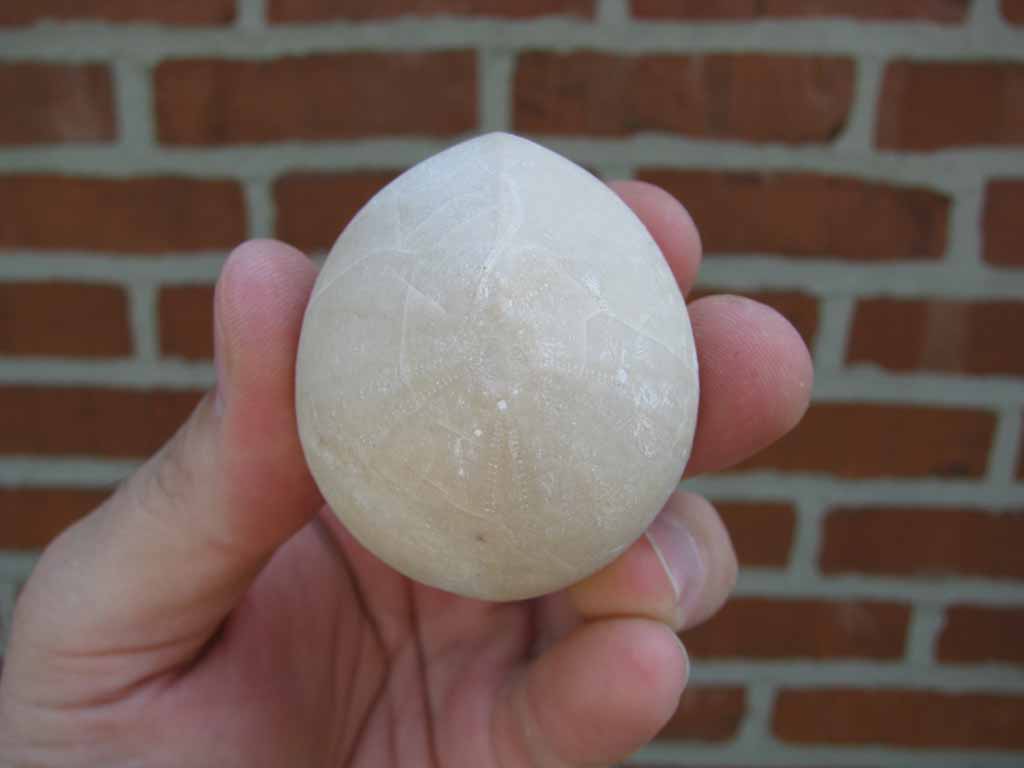
Echinocorys sp.

This fossil echinoid came from the chalk cliffs near Ault, France and is preserved with a pristine white calcite. Below is a Echinocorys sp. from the Cretaceous (Turonian) age and was found by my friend Gery.

Adapical surface (top)

Anterior (front)

Side profile

Posterior (Rear)

Adoral surface (underside or bottom)


For more info on Echinoid anatomy check out the Irregular Echinoid Terminology page at the British Chalk Fossils website.