Sunday, August 16, 2020

Two pelecypods from the Jeffersonville limestone

I have very few good Pelecypod fossils from the Jeffersonville formation. I have been fortunate to find a number of examples of Paracyclas sp. (as shown in this prior post) but the two specimens below do not fit that genera.

The first specimen is somewhat rough but recognizable as a pelecypod. There are two valves, the shell is oval in shape, and there is evidence of the hinge line at the rear of the shell. Faint concentric growth lines are visible on the surface portions of both shells but the preservation of the shells is not so good at preserving the upper parts of the shell such as the umbo. If I were to guess, this could be an example of Modiomorpha sp. which is very common in the Devonian, but there is not enough detail for me to be sure.

Right valve
Left valve
Dorsal margin.  If this were an external cast rather than internal cast you would not be able to see the raised ridge like seam between the valves.

Posterior
Ventral margin
Anterior

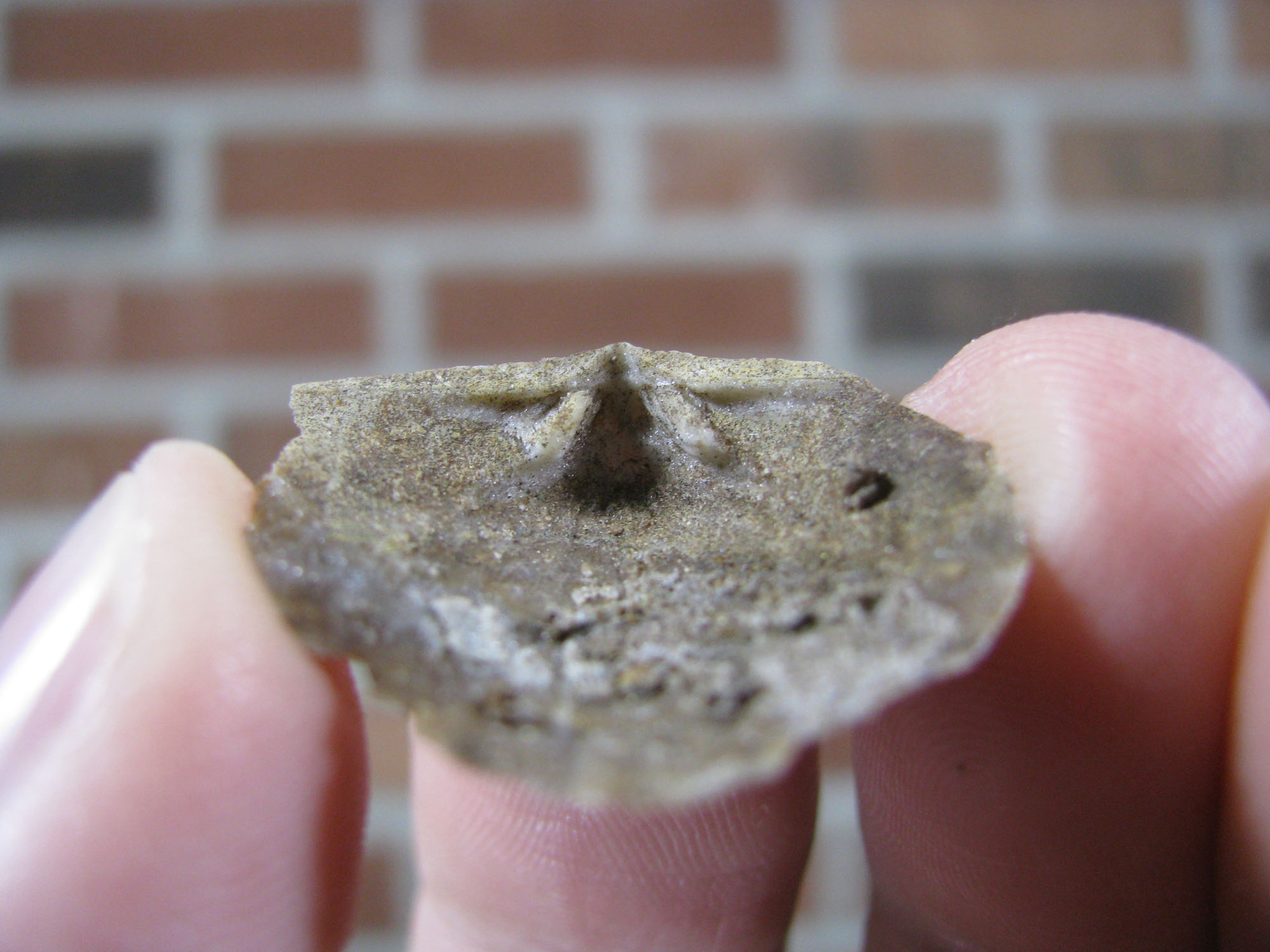
Specimen #2 is a single, partial valve impression. It is notable for the radiating ribs that extend from where the beak would be.  Due to the angle of the ribs, and overall shape of the shell I think this is a genera from the subclass Pteriomorpha, order Pectinoidea. Perhaps Actinopteria sp. which is a very common genus in the Devonian.

I found these two specimens near Lousiville, KY and believe they come from the Jeffersonville Limestone, dated to the Devonian period (Eifelian stage).


Friday, August 14, 2020

Dolatocrinus sp. crinoid stems from the Jeffersonville limestone

It is rare that you can ID a loose crinoid stem segment to the genus it is from but some forms are very distinct. Today's example of that are some stem sections from the crinoid Doloatocrius sp.  What makes the stems unique are periodic growths that form a wider ring than the rest of the stem, and also have vertical extrusions at 120 degree intervals. The extrusions look a little like "fins"

The specimens shown below were sent to me as part of an trade with Mike P. and come from the Jeffersonville limestone near Louisville, KY.  I did some research and cannot find any examples on the internet that show these stems in life position with a calyx attached. Also, in one of my previous blog entries I have a note with similar specimens found in Arkona, Canada that they belong to Megistocrinus sp. crinoids. That note may or may not be correct as I have seen pictures of stems attached to Megistocrinus nodosus calyx that do not show the "wing" like growths, just the thicker ring.

So for now I will keep the current label of Doloatocrius sp. until I can positively confirm otherwise.

Specimen #1


Specimen #2


Specimen #3


I received these specimens in an trade with Mike P. and they come from the Jeffersonville Limestone  near Louisville, KY and is dated to the Devonian period (Eifelian stage).

Thursday, August 13, 2020

Mound like Bryozoan from the Speed Limestone

I've found a few specimens of what appears to be a mounding Bryozoan that lived during the Devonian period during collecting trips to the Louisville, KY area. I've also received specimens from Mike P. via exchanges and he has them labelled as "Eridotrypa sp. from the Speed limestone".  The Speed limestone is a member of the Silver Creek formation (or North Vernon/Sellersburg limestone depending on the resource you look at) and is above the Jeffersonville limestone. 

I am unsure of the actual ID for these specimens as Eridotrypa is a genus known from the Ordovician and Silurian. I believe this is an example of an order Trepostomata type bryozoan (as is Eridotrypa) but the preservation is not good enough to really narrow the ID.  I'd suggest that an ID of Monotrypa sp. (which forms hemispherical colonies with flat bases and is known from the lower to middle Devonian of New York) would be more appropriate for the age of the specimens but for now they will have a question mark on my labels.

All the specimens I have are very light with some clearly being hollow as a rattling can be heard inside when turned.  It is my interpretation that these are partially preserved examples with the exterior being the most extensively replaced. These likely represent casts of the actual calcitic fossils that dissolved away during the silicification process. Since surface details are lacking, the original skeletons could also have been tumbled on the seafloor prior to fossilization.

A clutch of specimens that all show similar features

Specimen #1 - side view


Dorsal surface of the specimen showing the small corallites

Another side view that shows the layering and cells of the colony

Bottom of the specimen which has features that could either be from growth over a non level surface, or dissolution features prior to silicification of the fossil.

Specimen #2


Specimen #3


I received these specimens via trade. They come from a quarry in Clark County, Indiana which is near Louisville, KY. The fossils are dated (roughly) to the middle Devonian (Givetian stage).

Tuesday, August 11, 2020

Orthospirifer sp. brachiopod from the Jeffersonville Limestone

The Brachiopod Orthospirifer is a genus that I don't find as often in the Devonian aged sediments that typically collect in New York and Pennsylvania.  The specimen below was sent to me as part of an exchange from Mike P. who runs the excellent "Louisville Fossils and Beyond" blog.  The specimen is is a little compressed and the brachial valve is encrusted with an Auloporoid type coral.  The only other Orthospirifer that I have in my collection is from the Silica Shale of Ohio. Orthospirifer looks similar to Mediospirifer audaculus but the interarea is often curved and the brachial valve more convex.

Brachial valve dorsal surface with the Auloporoid encrustation

Anterior view

Pedicle valve view of dorsal surface

Posterior view

Posterior view turned 180 degrees

Right profile

A closer view of the Auloporoid encrustation. Unfortunately the preservation of the coral is not good enough to speculate on the genus or species.


I received this specimen in an trade with Mike P. and it comes from the Jeffersonville Limestone located in Clark County, IN which is near Louisville, KY and is dated to the Devonian period (Eifelian stage).

Sunday, August 9, 2020

Tropidoleptus carinatus brachiopod from the Sellersburg Limestone

Today's specimen is Tropidoleptus carinatus from the Sellersburg limestone of Indiana. The Sellersburg limestone is middle Devonian in age (Givetian stage) and lies above the Jeffersonville formation.  The fossils below are from two different individuals but show both valves of T. carinatus. I purchased these specimens from a seller on E-bay some years ago.

Brachial valve dorsal surface

Brachial valve ventral surface

View of the rear of the brachial valve with the attachment points for the brachioles shown

Pedicle valve dorsal surface

Pedicle valve ventral surface


Left side profile of pedicle valve

Posterior of pedicle valve

Anterior of pedicle valve

T. carinatus is very common in the middle to upper Devonian aged rocks of North America. Some of the best specimens I have found come from the Kashong shale member of the Moscow formation in New York.  I have never found examples of the species with individual valves before though, so these are special specimens in my collection.

These specimens come from the Sellersburg Limestone located in Clark County, IN which is near Louisville, KY and is dated to the Devonian period (Givetian stage).