Tuesday, June 28, 2016

Thamnopora sp. coral from the Martin formation of Arizona

By far the most prolific constituent of the fossils I found in the Martin formation in Arizona is Thamnopora sp.  This genera is also called Coenites in older literature.  It is most common as finger like branches covered in individual corallites, but also forms amorphous masses. Teichert mentions in his paper:
Among tabulate corals Thamnopora is by far the most commonly represented genus, and in many beds it occurs alone (fig. 26). Like Amphipora, the branches of Thamnopora colonies are seen in many outcrops on weathered surfaces, even on entirely dolomitized rocks. The habitat of the colonies is similar to that of the "Rasenriffe" (meadow or turf reefs) of German literature, which are not reefs but are horizontally extensive dense growths or thickets of branching corals, generally composed of one species. (See, for example, Hotz and others, 1955, p. 64, 76, 95.) Branching tabulate and phacelloid rugose corals formed this kind of biota in Devonian times in many parts of the world.
Here is a rock with lots of Thamnopora sp. branches emerging from it. Based on the size of the openings there may be more than one species present. There also appears to be a specimen of Disphyllum sp. present as well.


Here is a specimen that I etched out of the rock. It shows the amorphous mass like growth with branches that angle up.As I was photographing the specimen I noticed that there was a pattern near the base of the Thamnopora colony that looks like a Pachyphyllum corallum. You can see it in the second photo below and the last photo which is of the underside of the specimen. It appears that this Thamnopora colony either grew on an old Pachyphyllum colony or was living along side of it.


These specimens are from the Jerome member of the Martin formation (Devonian, Fransian stage) north of Payson, AZ.

References:
Teichert, C., 1965, "Devonian Rocks and Paleogeography of Central Arizona",  USGS Professional Paper 464

Langland, Jeffrey O. and Edith V., 2012, "Fauna of a 400-Million-Year-Old Coral Reef in
Arizona", Rocks and Minerals, 87:1, 40-44

Stumm, Erwin C., 1948, "Upper Devonian Compound Tetracorals from the Martin Limestone", Journal of Paleontology, Vol. 22:1, pp. 40-47

Saturday, June 25, 2016

Alveolites sp. coral from the Martin formation of Arizona

One of the more unusual looking pieces I found in the Martin formation of Arizona was a piece that resembles Alveolites sp. It is a flat topped piece with an epitheca on the underside and what appears to be a vertical growth element so that, in profile, it looks a little like a mushroom. The corallite openings on the dorsal surface are the most telling. They appear to be laying on their side and shaped a little like a fish scale. This is a diagnostic feature of Alveolites which is what leads me to believe my piece is of the same genus. The genera is listed by Teichert in his paper and illustrated in Langland's article.

Dorsal surface
Dorsal surface tilted and a little closer to show the corallite openings.
Profile
Ventral

This specimen is from the Jerome member of the Martin formation (Devonian, Fransian stage) north of Payson, AZ.

References:
Teichert, C., 1965, "Devonian Rocks and Paleogeography of Central Arizona",  USGS Professional Paper 464

Langland, Jeffrey O. and Edith V., 2012, "Fauna of a 400-Million-Year-Old Coral Reef in
Arizona", Rocks and Minerals, 87:1, 40-44

Stumm, Erwin C., 1948, "Upper Devonian Compound Tetracorals from the Martin Limestone", Journal of Paleontology, Vol. 22:1, pp. 40-47

Thursday, June 23, 2016

Syringopora sp. coral from the Martin formation of Arizona

I found one pebble of limestone from the Martin formation in Arizona that was shot through with a narrow, stick like coral that I believe is Syringopora sp. The genera is listed by Teichert in his paper and is illustrated by Langland in his article. The calices are very narrow, 3-5mm across and clustered but not in a central mass. Think of them more as loose spaghetti. My sample is small and there is not much exposed of the sides of individual calices, so could this possibly be a form of Aulocystis?


This specimen is from the Jerome member of the Martin formation (Devonian, Fransian stage) north of Payson, AZ.

References:
Teichert, C., 1965, "Devonian Rocks and Paleogeography of Central Arizona",  USGS Professional Paper 464

Langland, Jeffrey O. and Edith V., 2012, "Fauna of a 400-Million-Year-Old Coral Reef in
Arizona", Rocks and Minerals, 87:1, 40-44

Stumm, Erwin C., 1948, "Upper Devonian Compound Tetracorals from the Martin Limestone", Journal of Paleontology, Vol. 22:1, pp. 40-47

Monday, June 20, 2016

Disphyllum sp. coral from the Martin formation of Arizona

These next two specimens represent a new (to me) genera: Disphyllum. They are a colonial rugose coral with closely set, yet independent calices. It looks similar to Eridophyllum but the calices are shorter. Both specimens that are shown here are small clusters. I don't know if they form larger colonies or is these represent the typical form.

I looked through Stumm's paper and did not find any mention of Disphyllum. I based my ID of these fossils on Langland's article in Rocks and Minerals where they illustrate two species but do not list specific names. Teichert's paper does list several species of Disphyllum.

Specimen #1 - Dorsal view
Dorsal view rotated 90 degrees
Right profile
Left profile


Specimen #2 - Dorsal surface

The next four pictures are the specimen in profile view, rotated 90 degrees in each subsequent photo.


These specimens are from the Jerome member of the Martin formation (Devonian, Fransian stage) north of Payson, AZ.

References:
Teichert, C., 1965, "Devonian Rocks and Paleogeography of Central Arizona",  USGS Professional Paper 464

Langland, Jeffrey O. and Edith V., 2012, "Fauna of a 400-Million-Year-Old Coral Reef in
Arizona", Rocks and Minerals, 87:1, 40-44

Stumm, Erwin C., 1948, "Upper Devonian Compound Tetracorals from the Martin Limestone", Journal of Paleontology, Vol. 22:1, pp. 40-47

Saturday, June 18, 2016

Family Fistuliporidae (?) bryozoan colony from the Martin formation of Arizona

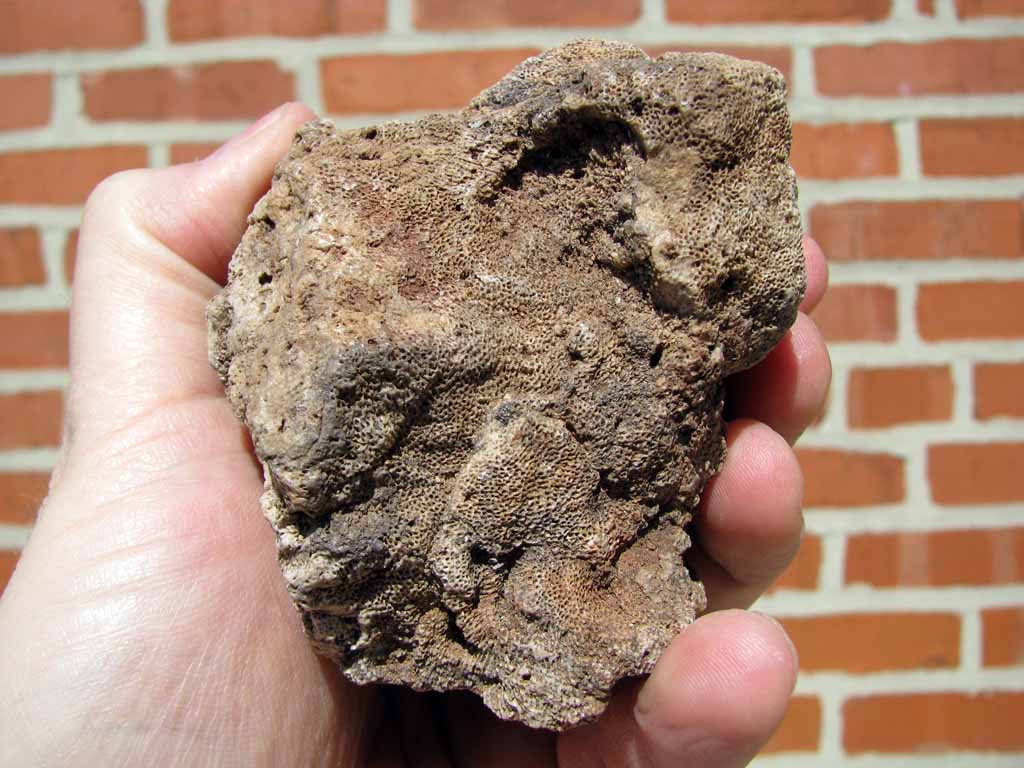
One of the most mysterious fossils that I found in the Martin formation of Arizona is this large chuck of silicified rock. The softball sized piece is composed entirely of a single colony of some sort of coral or bryozoan. As you can see in the pictures below, it is a very three dimensional piece with "pores" on all side and every surface. The small openings vary in shape but do show some "flowing" features that I interpret as a growth pattern. I don't think this is the coral Alveolites as the corallite openings of that genera are flattened and resemble fish scales. It's not likely a sponge due to the many small openings and growth patterns which sponges or stromatoporoids do not possess. I'm thinking that this is part of a massive Bryozoan colony of some species in the Family Fistuliporidae. I have found similar large and massive colonial structures like this one from the Hungry Hollow mbr. of the Widder formation from Hungry Hollow, Ontario.


Closer views of the small openings.


These specimens are from the Jerome member of the  Martin formation (Devonian, Fransian stage) north of Payson, AZ.