Saturday, January 14, 2012

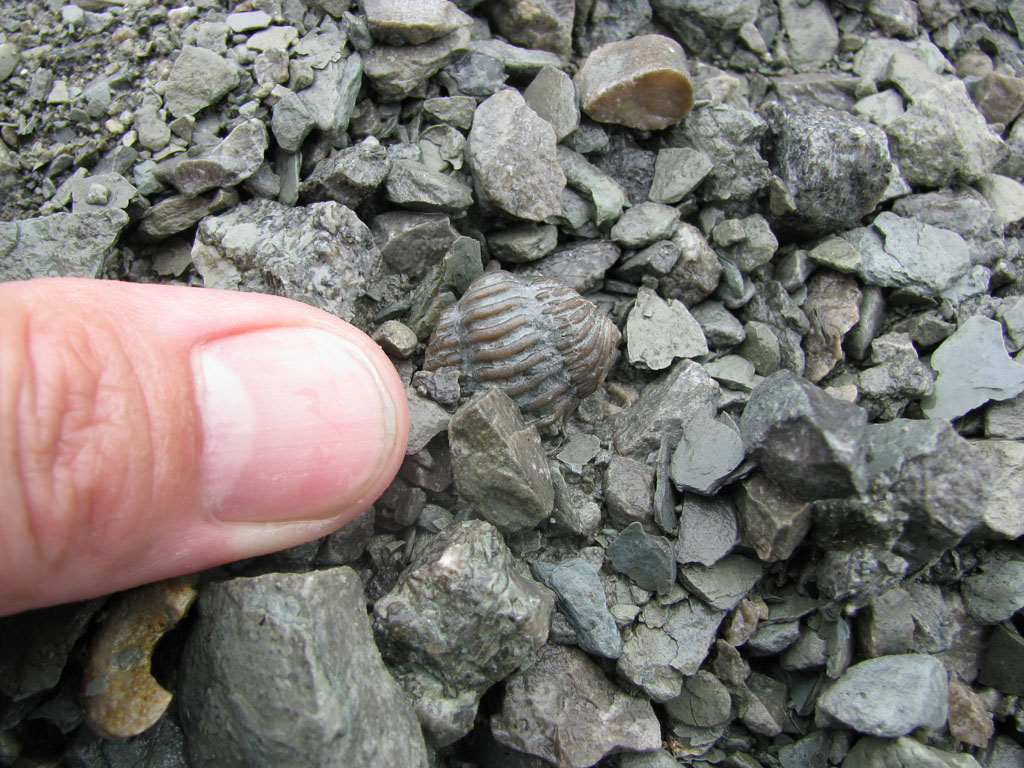
Hypodicranotus striatulus trilobite hypostome from the Verulam

One of the nice things about the middle Ordovician aged (Katian/Mohawkian stage) Verulam formation is the abundance or Trilobite remains. Most times they are whole specimens, like the Flexicalymene I found, but more often they are the scattered bits of the skeleton left after a molt. Below is one such piece which is a Hypostome from a trilobite called Hypodicranotus striatulus.


The Hypostome is thought to be one of the mouth parts on a trilobite. Some research suggests that they used them like claws in order to hold prey in place while feeding or that they were an integral part of the feeding apparatus.

The website Trilobites.info has a great page here that discusses Hypostomes and their varied shapes as well as how they were attached to the cephalon of trilobites.

Harvard's website has a great set of pictures of a whole specimen, click here, as well as some of the Hypostomes from the Walcott-Rust quarry in NY.

You can check out another Hypostome from a Hypodicranotus in the gallery of my friend Kevin on the Fossil Forum here. Thanks to Kevin for IDing the specimen for me.

Thursday, January 12, 2012

Anazyga recurvirostra plate from the Verulam

Below is a plate that is packed with Anazyga recurviostra brachiopods. I found it at a quarry in the Verulam formation up in Canada. I like that the piece has so many individual brachiopods that are in good shape and well exposed. The fact that they are all intact tells me they were probably swept together during a storm event. The only other fossil included in the mass of brachiopods is a small trilobite pygidium piece, possibly from a small Isotelus.


Detail of the pygidium and brachiopods. Note that the brachiopods are facing in random directions. This is another indication of a storm event. Had they been grouped together by a current many of the shells would be oriented in the same direction.

Thanks to my friend Kevin for the correction that the brachiopods were Anazyga and not Zygospira as well as the Isotelus ID. The Verulam formation is middle Ordovician in age (Katian/Mohawkian stage).

Tuesday, January 10, 2012

Felxicalymene trilobite from the Verulam fm.

On the last trip I took up to the Verulam formation quarries this past fall, I finally found my first enrolled Flexicalymene trilobite. Here it is "in situ" as I found it.

I found the trilobite on the large mounds of crushed rock that had been set aside as a reserve. It's rather remarkable that the fossil survived the crushing process intact. Here is what it looked like when I picked it up.

And here it is once I got it home to be cleaned up. Looking down on the cephalon, essentially the "top" of the specimen.

Turned 90 degrees to look at the "front" of the specimen with the interlocking cephalon and pygidium. You can see a little bit of the cephalon's egde is chipped off. Otherwise the specimen is in great shape.

Thoracic segments on the "bottom of the specimen.

"Back" side of the specimen with more thoracic segments.

A profile view of the specimen. You can see that it has been slightly compressed and is not a truly round shape.


I was at the quarry that day with my friend Kevin who then showed me up by finding an enrolled specimen of a small Isotelus in the same piles. However he hasn't yet found any Monoplacophorans so I can still hold that over his head. *grin* The Verulam formation is middle Ordovician in age (Katian/Mohawkian stage).

Sunday, January 8, 2012

Archinacella patelliformis from the Verulam fm.

On my trips up to Canada I make a point to get up to the Brechin area and visit the Ordovician aged rock quarries. On one such trip I found the piece below which is rife with a Monoplacophoran called Archinacella patelliformis. Monoplacophorans (latin for "bearing one plate") are gastropod like mollusks which have a cap shaped shell rather than a spiral shape. They are considered very primitive and there is thought that they are representative of the original ancestor of all mollusks.

Upon a wide view one doesn't see too much but the eye is drawn to the light colored oval resting on the darker colored fossil (possibly a bit of Trilobite skeleton).

A closer view reveals that the oval is actually a shell with growth rings.

Here is another view with the light angled so you can see the shell details a bit better.

As I looked over the rock some more I found several more specimens of this unusual fossil. I think I found seven examples of varying sizes on this same piece of rock.


Here is another specimen that I found on a different trip. It's from a different layer as you can see from the way the limestone has weathered. Again you don't really notice it unless your looking for something that doesn't fit. I picked up this piece intitially because of the Sowerbyella brachial valve and the partial Flexicalymene cephalon.

Upon closer inspection I saw the cap like shell of a Monoplacophoran.

An even closer view. Note that the very top of the shell is nearly flat.


The specimens above were found in the Verulam formation which is middle Ordovician in age (Katian stage, equivalent to the lower Caradocian stage in Europe and the Mohawkian stage in the US).  I based my ID of the fossils on the book "South-Central Ontario Fossils, A Guide to the Ancient Marine Life of the Region" by William A. Hessin, 2009. Thanks to my friends Kevin and Joe for taking me to these quarries in the first place.

Friday, January 6, 2012

Pleurocystites squamosus from the Verulam fm.

Pleurocystites is a somewhat common cystoid found in the middle to upper Ordovician. I've managed to find one in the Verulam formation of southern Ontario. The specimen displayed below is a Pleurocystites squamosus and was cleaned off by my friend Kevin. It is associated with a Rafinesquina alternata (white shell), a couple of what I think are Plaesiomys brachiopods along with other brachiopod and bryozoan debris.


A closer view of the calyx. You can see just the stumps of the two arms that once sprouted from the top of the calyx. Unfortunately they must have weathered away or were on another piece of rock that this one broke off of.


One of the interesting features are the "vent" like openings, called dichopores, that are found in three places around the body. This is a closer view of one. Based on what information I have been able to find so far, dichopores were respiratory structures.


The specimen above was found in the Verulam formation which is upper Ordovician in age (Katian stage, equivalent to the lower Caradocian stage in Europe and the Mohawkian stage in the US). Thanks to my friend Kevin for the field ID and for cleaning the fossil off in his prep lab.